The post Industrial Rooftop Safety: A Complete Guide to Guardrails, Walkways & Fall Protection appeared first on Chemey.
]]>The post Industrial Rooftop Safety: A Complete Guide to Guardrails, Walkways & Fall Protection appeared first on Chemey.
]]>The post Safety Gates vs Guardrails: Which Protection System Fits Your Facility? appeared first on Chemey.
]]>The post Safety Gates vs Guardrails: Which Protection System Fits Your Facility? appeared first on Chemey.
]]>The post Industrial Fall Protection Systems: The Complete Rooftop Safety Guide appeared first on Chemey.
]]>The post Industrial Fall Protection Systems: The Complete Rooftop Safety Guide appeared first on Chemey.
]]>The post EnduRail Metal Roof Safety Railings for Industrial Facilities appeared first on Chemey.
]]>The post EnduRail Metal Roof Safety Railings for Industrial Facilities appeared first on Chemey.
]]>The post Beyond Edge Protection: Engineering Safe RooftopWalkways for Industrial & PEB Facilities appeared first on Chemey.
]]>In rooftop safety discussions, fall protection is often limited to edge protection systems such as lifelines or guardrails. However, real operational risks rarely occur only at the roof perimeter.
Modern industrial rooftops — especially Pre-Engineered Buildings (PEB), warehouses, data centers, and process plants — require maintenance personnel to move safely across the roof, not just near its edges.
A safe rooftop is therefore not defined only by protection at boundaries, but by controlled and engineered movement pathways.
This is where rooftop walkways become a critical design element.
1. The Missing Link in Rooftop Safety Design
Many facilities provide:  Edge guardrails
but overlook:  Safe walking routes between equipment.
Common site observations include:
-
- Maintenance staff walking directly on roof sheets
-
- Unpredictable movement paths
-
- Damage to roofing panels
-
- Increased slip and trip hazards
-
- Unsafe shortcuts near edges
Without defined pathways, even compliant fall protection systems fail to address operational risk.
2. Engineering Purpose of Rooftop Walkways
Rooftop walkways are not merely access platforms — they serve multiple engineering functions:
Load Distribution : Walkways distribute point loads from personnel and tools, preventing deformation of roof sheets.
Movement Control : They guide maintenance teams along predetermined safe routes.
Slip Resistance : Designed surfaces improve traction during dust, moisture, or monsoon conditions.
Equipment Accessibility : Allows safe approach to HVAC units, solar panels, exhaust systems, and inspection zones.
3. Integration with Guardrail Systems
The most effective rooftop safety strategy combines:
-
- Edge protection (guardrails)
-
- Defined walkways
-
- Crossover platforms
-
- Controlled access points
Together, these create a passive safety ecosystem where workers naturally remain within protected zones.
Consultants increasingly adopt this integrated approach because it reduces reliance on PPE-based safety procedures.
4. Design Considerations for Consultants
When evaluating rooftop walkway systems, engineers should consider:
Roof Type Compatibility
-
- Industrial Troughed sheet roofs
-
- Standing seam systems
-
- Concrete slabs
Structural Fixing Method
-
- Non-penetrative or minimal penetration solutions
-
- Waterproofing integrity
Environmental Durability
-
- Corrosion resistance
-
- UV exposure
-
- Industrial chemical environments
Maintenance Workflow Mapping
Walkways should follow actual equipment servicing routes — not geometric layouts.
Future Expansion
Provision for additional equipment installation and pathway extension.
5. Operational Benefits Often Overlooked
Facility operators report significant improvements after installing engineered walkways:
-
- Faster maintenance execution
-
- Reduced roof damage
-
- Lower safety supervision requirements
-
- Improved compliance audits
-
- Better worker confidence
These benefits often justify walkway integration during initial design rather than retrofit.
6. Consultant Recommendation
During early design stages, rooftop safety evaluation should include:
Where will maintenance personnel walk? How frequently will equipment be accessed? Are pathways naturally guiding safe behavior? Can safety function without procedural enforcement?
Designing walkways together with guardrail systems transforms rooftop safety from compliance-driven to engineering-driven.
Conclusion
Edge protection prevents falls — but engineered walkways prevent unsafe movement.
As rooftop equipment density continues to increase, consultants play a key role in designing rooftops that are safe, maintainable, and operationally efficient throughout the facility lifecycle.
The post Beyond Edge Protection: Engineering Safe RooftopWalkways for Industrial & PEB Facilities appeared first on Chemey.
]]>The post Engineering Considerations for Rooftop Safety appeared first on Chemey.
]]>Industrial and pre-engineered building (PEB) rooftops are no longer passive surfaces. Modern facilities accommodate HVAC systems, solar installations, cable trays, exhaust units, inspection routes, and maintenance equipment that require periodic human access throughout the building lifecycle.
Despite this operational reality, design teams often address rooftop fall protection late in the design process. They typically specify horizontal lifeline systems as a compliance measure instead of evaluating long-term safety performance.
For consultants and design engineers, the key question is no longer “Do the plans provide adequate fall protection?” but rather:
“Is rooftop access inherently safe during real maintenance conditions?”
This article outlines the critical engineering considerations that consultants and design engineers should use when making rooftop safety strategy decisions during the design stage.
Understanding Active vs Passive Protection Philosophy
Active Protection (Lifeline Systems)
Active systems rely on worker participation:
- Harness usage
- Proper anchorage connection
- Continuous attachment discipline
- Training and supervision
While compliant with standards, performance depends heavily on human behavior.
Passive Protection (Permanent Guardrails)
Passive systems eliminate exposure to fall hazards:
- No user action required
- Continuous edge protection
- Always active regardless of worker skill level
Global safety engineering increasingly prioritizes hazard elimination over hazard control, especially for frequently accessed roofs.
Frequency of Rooftop Access — The Most Underestimated Parameter
During design reviews, rooftops are often classified as “occasional access.”
However, operational data shows otherwise.
Typical access frequency:
- HVAC inspection: monthly or quarterly
- Filter replacement: periodic
- Electrical and telecom servicing
- Solar maintenance
- Leak inspections during monsoon seasons
If access is recurring, reliance solely on PPE-based systems introduces operational risk.
Engineering implication:
Repeated access favors passive protection systems integrated into the building design.
Maintenance Movement vs Anchorage Layout
A common post-handover observation is misalignment between:
- Natural walking paths of maintenance teams( Rooftop walkway)
- Installed lifeline anchorage positions
This leads to:
- Workers disconnecting temporarily
- Unsafe shortcuts near roof edges
- Reduced system usage over time
Design consideration:
- Define maintenance pathways early. ( Designed Rooftop walkway)
- Provide safe circulation routes, crossover platforms, and protected service zones.
Safety should follow workflow — not force workflow adaptation.
Structural Design Considerations
Consultants should evaluate rooftop safety loads during structural planning rather than retrofit stages.
Key aspects include:
- Edge load capacity for guardrail systems
- Fixing methodology compatible with roof sheets or concrete slabs
- Wind load effects on elevated guardrails
- Corrosion resistance for coastal or chemical environments
- Compatibility with PEB structural members
Early integration allows optimized structural support without later reinforcement.
Lifecycle Cost vs Initial Cost
Lifelines often appear economical during procurement; however, lifecycle evaluation reveals additional factors:
- Periodic inspection and recertification
- Replacement of damaged cables or anchors
- Training requirements
- Work delays due to attachment procedures
- Retrofit requests from facility operators
Permanent guardrails typically involve higher initial investment but lower operational dependency and maintenance complexity.
Consultants increasingly evaluate safety using Total Cost of Ownership (TCO) rather than CAPEX alone.
Human Factors Engineering
Most rooftop incidents are linked to:
- Time pressure during maintenance
- Weather exposure
- Improper harness usage
- Fatigue or complacency
Engineering controls that reduce reliance on perfect human behavior significantly improve safety outcomes.
Passive systems align better with human factors engineering principles.
Retrofit Complexity — A Common Project Outcome
Facilities frequently request safety upgrades after commissioning due to operational challenges.
Retrofit challenges include:
- Shutdown requirements
- Limited fixing access
- Structural modifications
- Waterproofing risks
- Increased installation cost
Integrating permanent access protection during design avoids these constraints.
Recommended Consultant Approach
During early design stages, consultants should evaluate:
- Expected maintenance frequency
- Equipment density and layout
- Safe access routes and crossover needs
- Edge exposure zones
- Future expansion possibilities
- Compliance responsibility during building operation
A layered approach combining defined pathways, protected edges, and controlled access zones delivers the most sustainable safety outcome.
Conclusion
Rooftop safety decisions should not be treated as a late-stage compliance checkbox. They are fundamentally engineering decisions affecting building operability for decades.
As industrial facilities become more service-intensive, consultants play a critical role in shifting design philosophy from reactive protection toward built-in safety.
Early evaluation of passive protection strategies helps teams create rooftops that meet compliance requirements while remaining safe, maintainable, and future-ready.
The post Engineering Considerations for Rooftop Safety appeared first on Chemey.
]]>The post Rooftop Modular Guardrail Systems: A Smart Safety Solution for Industrial Facilities appeared first on Chemey.
]]>The post Rooftop Modular Guardrail Systems: A Smart Safety Solution for Industrial Facilities appeared first on Chemey.
]]>The post Rooftop Access Solutions – Safe, Compliant & Engineered Access Systems appeared first on Chemey.
]]>The post Rooftop Access Solutions – Safe, Compliant & Engineered Access Systems appeared first on Chemey.
]]>The post Top 5 Ways to Enhance Fall Safety on Your Warehouses and Shop Floor appeared first on Chemey.
]]>Understanding Ground-Level Fall Protection
Before we get into the nitty-gritty, let’s discuss the often-overlooked dangers lurking at ground level. Sure, we think of fall hazards as high-up issues, but many fall-related injuries occur right at our feet. The risks are real—and preventable—from machinery and lifting operations to stacked materials and unsecured tools.
Common Ground-Level Fall Hazards
Here are some of the usual suspects:
- Stacked Materials: Elevated or not, these can be dangerous if improperly managed.
- Forklift Operations: A slip, a trip, or a misplaced tool can lead to disaster.
- Unsecured Tools: Anything loose above can quickly become a hazard below.
- Machinery: Risky operations may lead to lacerations, electrocution, etc.
- Lifting Operations: Suspended equipment and materials pose serious threats.
Remember, fall hazards aren’t just about heights. Tripping, slipping, and falling objects are issues you can’t afford to ignore.
Top 5 Tips to Boost Fall Safety on the Shop Floor
#1: Don’t Overload Storage Areas
While keeping workers safe is the top priority, preventing falling objects is just as crucial. The secret sauce? Effective material storage management. Here’s how to do it right:
- Avoid overcrowding: Keep storage areas spacious and clutter-free.
- Secure your items: Make sure everything is firmly in place.
- Stay organized: A tidy space is a safe space—no tripping over loose materials here!
#2: Enhance Mezzanine Access and Security
Mezzanines offer great storage solutions, but they need to be secure without becoming inaccessible. Here’s how to strike the balance:
- Follow OSHA requirements: Safety first, compliance always.
- Clear the area: Keep mezzanine surroundings free of obstacles.
- Smart storage placement: Keep storage zones away from entry points.
- Modular guardrails: These should be customizable and adaptable as your needs evolve.
- Invest in Pallet / Mezzanine gates: One side open at a time for controlled access.
#3: Guard Machines Without Sacrificing Accessibility
Protecting machinery shouldn’t mean blocking access for those who need it. Here’s how to safeguard your equipment without slowing down operations:
- Modular railing: Customizable and easy to install, this is your best friend.
- Self-closing safety gates: Vertical lift gates are ideal for tight spaces.
- Strategic machine placement: Keep dangerous equipment out of high-traffic zones and consider remote-operated options with built-in safety features.
#4: Identify Machine Hazards Like a Pro
Effective machine guarding starts with a sharp eye and a solid understanding of OSHA standards. Watch out for:
- Exposed moving parts: These can lead to serious injuries if not properly shielded.
- Sharp components: Anything that can cut, pierce, or crush needs guarding.
- High-voltage areas: Exposed wiring is a no-go.
- Unsecured machines: Bolting down equipment is essential.
Always know where the power shut-offs are and never block critical access points with barriers.
#5: Tackle Spills and Slip Hazards Head-On
Spills and slippery surfaces are a leading cause of falls, but they’re entirely preventable. Keep an eye on:
- Oil slicks: Mobile machinery can leave these in its wake.
- Dust and debris: Cutting or grinding equipment can create slippery particulates.
- Unanchored mats: These can be a hidden danger if not properly secured.
- Chemical spills, Particularly in processing areas.
- Condensation: Particularly around machines and cold storage.
Implement strict cleaning protocols and ensure well-maintained surfaces to minimize slip hazards.
A Safer Shop Floor Starts Here
Fall protection isn’t just for those working at heights—it’s essential at every level of your work. From smart storage practices to vigilant maintenance, these tips will help you to create a safer environment for everyone.
Would you like to know more about emerging technologies and trending solutions for fall protection when working at heights or Safety on the Shop Floor?
For more information, call +91 9099033719 or send an e-mail to contact@chemey.com
The post Top 5 Ways to Enhance Fall Safety on Your Warehouses and Shop Floor appeared first on Chemey.
]]>The post Mitigating Fall Hazards in Oil & Gas Refineries: The Critical Role of Self-Closing Safety Gates appeared first on Chemey.
]]>The Unique Challenges of Refinery Fall Protection:
- Constant Movement: Refinery workers frequently access different levels and areas, making consistent fall protection difficult.
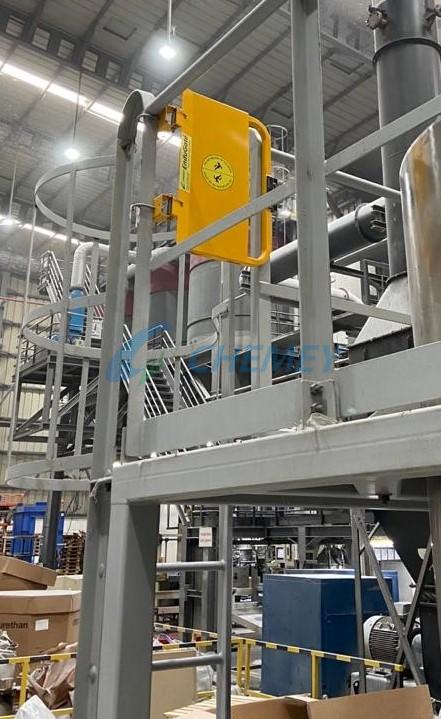
- Varying Hazards: Openings can range from ladder access points to large equipment platforms.
- Harsh Conditions: Equipment can degrade quickly in the corrosive environment of a refinery.
Why Self-Closing Safety Gates Are a Game-Changer:
- Passive Protection: Unlike harnesses that require active engagement, self-closing gates provide automatic protection, reducing the risk of human error.
- Versatility: These gates can be installed on various openings, from small ladder access points to larger platform edges.
- Durability: Chemey’s self-closing safety gates are specifically designed to withstand the harsh conditions of a refinery, ensuring long-lasting reliability.
- Compliance: They meet or exceed OSHA standards for fall protection, helping your refinery maintain compliance and avoid costly fines.
- Areas Within an Oil & Gas Facility Where a Safety Gate is Applicable:
Self-closing safety gates are particularly useful in many areas or operational needs. These include:
- Equipment Access Points: Protecting openings around machinery and tanks.
- Ladder Landings: Preventing falls from elevated ladder platforms.
- Cage Ladder Landings: Areas of intermediate landing platforms.
- Narrow Walkways: Where a swinging gate would obstruct passage.
Features and benefits of EnduGate self-closing safety gates
- Spring Loaded: The gate will automatically close behind the user.
- Adjustable to the size: The standard size model is available up to a 1000 mm wide opening. You can cut it to fit the narrower opening.
- Easy to Install: They are quick and easy to install with a universal clamping system, which saves time and money. Accessories are available to fix wide openings without stop posts.
- Durable Finish: All safety gates are available in galvanized steel finish or yellow powder coated.
CHOOSE OSHA-COMPLIANT SAFETY GATES TO MITIGATE FALL HAZARD
Don’t leave fall protection to chance. Investing in self-closing safety gates is a proactive step towards creating a safer refinery environment. Contact Chemey today to learn how our safety gate solutions can help you protect your workers and prevent falls.
- Schedule a free consultation to assess your fall protection needs.
call +91 9099033719 or send an e-mail to contact@chemey.com
- Explore our full range of safety gate products Self-Closing Safety Gates for Industrial Use | Chemey
The post Mitigating Fall Hazards in Oil & Gas Refineries: The Critical Role of Self-Closing Safety Gates appeared first on Chemey.
]]>