
Data centers are changing rapidly. AI workloads, higher-density computing, advanced cooling systems and expanding infrastructure are increasing the complexity of modern facilities.
That growth is creating a safety challenge beyond the server room: rooftops and elevated service areas are becoming increasingly busy maintenance environments.
Cooling equipment, HVAC systems, generators, cable routes, pipework, ducts and other building services can create complex access requirements. Maintenance teams need to inspect, service and replace equipment without relying on improvised routes or unnecessary exposure to fall hazards.
This makes data center rooftop safety an important part of facility design.
The modern question is not simply, “Is the roof protected at the edge?” It is, “Can maintenance teams safely reach every serviceable asset, move around obstacles and work at height without disrupting critical operations?”
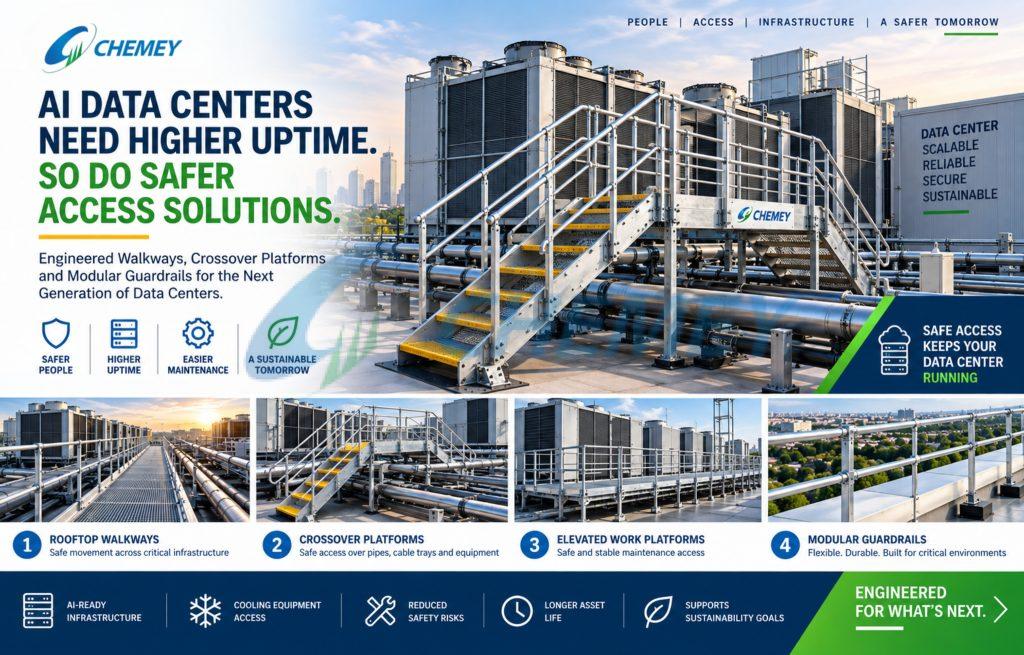
A well-designed rooftop safety strategy can combine engineered walkways, crossover platforms and modular guardrails to create defined, repeatable and maintainable access routes.
Why Data Center Rooftop Safety Is Becoming a Bigger Issue
The data center sector is expanding quickly, particularly as AI increases demand for high-density computing infrastructure. JLL’s August 2026 India data center report projects India’s capacity to rise from about 1.6 GW in mid-2026 to 6 GW by 2029, with AI demand and hyperscale investment among the major growth drivers.
At the same time, high-density AI infrastructure creates greater cooling requirements. S&P Global’s 2026 research notes that AI workloads generate substantial heat and that interest in liquid cooling is increasing.
For facility teams, this means more mechanical infrastructure, more service points and potentially more maintenance activity around critical plant.
Rooftop access therefore needs to be considered as part of the facility’s lifecycle design—not as an afterthought.
The New Data Center Rooftop: A Maintenance Environment, Not an Empty Roof
A modern data center roof may contain:
• Chillers and cooling equipment
• Dry coolers and condenser units
• HVAC and ventilation equipment
• Generators and supporting equipment
• Pipework and process lines
• Cable trays and electrical routes
• Ductwork
• Solar or energy infrastructure
• Service platforms and access equipment
These systems rarely exist in a simple grid. Equipment can create changes in level, narrow passages and physical obstructions.
That is why rooftop safety should be designed around actual maintenance movement rather than simply around the roof perimeter.
1. Engineered Walkways Create Defined Maintenance Routes
A rooftop walkway provides a dedicated route for maintenance personnel instead of requiring them to walk directly across the roof surface.
For data centers, walkways can help:
• Define predictable maintenance routes
• Improve traction and pedestrian movement
• Reduce unnecessary traffic across roof surfaces
• Protect sensitive roof membranes where the system is designed for the application
• Connect equipment service areas
• Support repeatable inspection and maintenance workflows
The important design principle is that the walkway should follow the actual service route.
2. Crossover Platforms Solve the Obstacle Problem
Data center rooftops are rarely free of obstacles. Pipework, cable trays, ducts, HVAC equipment and structural elements can interrupt otherwise straightforward routes.
A crossover platform creates a dedicated route over these obstacles.
Typical applications include:
• Crossing pipework
• Crossing cable trays
• Crossing ducts
• Moving over equipment or roof-level obstructions
• Connecting areas at different elevations
• Providing safer access between adjacent service zones
Chemey’s modular aluminum EnduStep Crossover Platform is designed to create safe routes over rooftop or floor-level obstructions and can be custom-designed for site-specific width, height, slope and obstacle conditions. Chemey also recommends checking roof-sheet point-load capacity before rooftop installation.
3. Modular Guardrails Provide Collective Edge Protection
Walkways solve movement problems, but they do not replace edge protection.
Where a maintenance route approaches an exposed edge, a suitable guardrail system can provide collective protection.
Chemey’s EnduRail system is a modular railing and guardrail solution designed for industrial structures, walkways, work platforms and rooftop applications. Chemey describes its system as using marine-grade aluminium structural fittings, modular connections and configurations that can be modified or repaired as site requirements change.
For data centers, modularity can be valuable because cooling and service layouts may evolve as infrastructure is upgraded.
4. Why Modular Systems Matter for Data Center Projects
Data centers are designed for long operating lifecycles, but the equipment installed within them can change much faster.
Cooling systems may be upgraded. Additional equipment may be installed. Cable routes can change. Maintenance access requirements can evolve.
A modular system can provide:
• Easier configuration changes
• Component replacement
• Extension of existing routes
• Faster installation
• Reduced dependence on field welding
• Better adaptability to changing layouts
5. Protecting Roof Membranes and Critical Building Infrastructure
Data center buildings have critical waterproofing and building-envelope requirements. Access systems therefore need to be coordinated carefully with the roof construction.
Before specifying a walkway or crossover, engineers should review:
• Roof type
• Roof membrane
• Structural capacity
• Point loads
• Fixing method
• Waterproofing details
• Wind exposure
• Equipment clearances
• Future maintenance routes
Chemey’s crossover guidance recommends checking roof-sheet point-load capacity before installing a crossover on a roof.
The correct engineering approach is therefore not simply “install a walkway.” It is “design an access route that is compatible with the roof and the equipment environment.”
6. Cooling Equipment Access Is a Major Design Consideration
Cooling infrastructure is central to data center operations, and AI-driven workloads are increasing the importance of efficient thermal management.
Maintenance teams may need access to filters, service panels, fans, motors, valves, pumps, sensors, pipe connections, electrical components and control equipment.
Where equipment is elevated, a level maintenance platform may be required. Where equipment rows are separated by pipework or other obstacles, crossover platforms can provide a safer route. Where the route approaches an exposed edge, guardrails can extend the protected zone.
7. Designing for 24/7 Operations
Data centers operate continuously. Maintenance may occur during planned service windows, at night, during emergency response, equipment replacement, commissioning or expansion projects.
This makes predictable access especially important.
A maintenance team should not have to improvise a route every time it needs to reach critical equipment.
Defined walkways, crossovers and protected access routes can help create a repeatable maintenance environment.
8. Safety Should Be Designed Before Equipment Layout Is Finalized
A common project challenge is adding safety infrastructure after the rooftop has already been filled with equipment.
A better design sequence is:
1. Map all maintainable equipment.
2. Identify how technicians will reach each service point.
3. Establish primary and secondary maintenance routes.
4. Identify obstacles and changes in level.
5. Define where walkways are required.
6. Add crossover platforms where routes are interrupted.
7. Identify exposed edges and add guardrails where required.
8. Review roof loading, waterproofing and fixing details.
9. Validate the design against applicable standards and local requirements.
10. Document the final access strategy for operations and maintenance teams.
9. A Data Center Rooftop Safety System Should Work as One Network
Think of the rooftop as an access network:
Roof Access → Defined Walkway → Crossover Platform → Cooling Equipment → Protected Service Zone → Guardrail / Edge Protection
Each component solves a different problem.
Walkways manage movement. Crossovers manage obstacles and level changes. Guardrails manage exposed edges. Platforms provide stable working areas where required.
Together, they create a more predictable maintenance environment.
10. What Consultants and Data Center Operators Should Check
Structural:
• Roof construction and load capacity
• Equipment support structures
• Wind and environmental corrosion loads
• Point loads from access systems
Operational:
• Equipment maintenance frequency
• Technician routes
• Service clearances
• Emergency access
• Future expansion
Safety:
• Roof edges
• Level changes
• Obstructions
• Fragile areas
• Slips and trips
• Access openings
Lifecycle:
• Modifications
• Component replacement
• Inspection
• Corrosion
• Long-term maintenance
11. Why Modular Rooftop Safety Is Relevant to India’s Data Center Growth
JLL’s August 2026 India data center report projects capacity growth from approximately 1.6 GW in mid-2026 to 6 GW by 2029, driven in part by AI adoption and hyperscale investment.
KPMG’s 2026 India data center analysis also highlights the ecosystem around design, construction, power, cooling, network infrastructure and lifecycle services.
For safety-system suppliers, the opportunity is broader than supplying a single guardrail. New data center projects require coordinated solutions for rooftop access, maintenance walkways, crossovers, work platforms, modular guardrails, equipment access and edge protection.
12. Chemey’s Data Center Safety Opportunity
Chemey can position its data center offering around a simple proposition: “Safe, engineered access for critical data center infrastructure.”
Its portfolio maps naturally to common rooftop maintenance requirements:
• Rooftop Walkways — defined maintenance routes
• EnduStep Crossover Platforms — movement over obstacles and changes in level
• EnduRail Modular Guardrails — collective edge protection
• Safety Gates — protected access points
• Work Platforms — equipment service areas
• Aluminum Grating — walkways, platforms and industrial access applications
Chemey’s access solutions describe walkway systems for metal roofs, RCC roofs and complex layouts, and crossover systems custom-engineered for unequal heights, level differences and opposing slopes.
Frequently Asked Questions
Why is Aluminum preferred metal in Data center access solutions?
Aluminum is used in data center enclosures because it enhances cooling, speeds construction, reduces weight, and supports modularity, all while maintaining durability and lowering long-term operational costs. These advantages make it a foundational material for modern, high-density, AI-driven data center environments. Chemey’ most solutions are of aluminum considering lightweight with good structural properties and best corrosion resistance in humid environment.
What is data center rooftop safety?
Data center rooftop safety is the engineering approach used to provide safe access, movement and maintenance around rooftop equipment, exposed edges, obstacles and elevated service areas.
Why do data centers need rooftop walkways?
Data centers contain cooling, electrical and mechanical equipment that requires regular maintenance. Engineered walkways can provide defined routes and reduce uncontrolled movement across roof surfaces.
What are crossover platforms used for in data centers?
Crossover platforms provide safe routes over obstacles such as pipework, cable trays, ducts and equipment, and can also connect areas at different levels.
Why are modular guardrails useful for data centers?
Modular guardrails can provide collective edge protection while allowing changes, extensions and repairs as the facility layout evolves.
How should rooftop safety be designed for AI data centers?
Design should begin with the equipment and maintenance workflow. Map service points, define routes, identify obstacles and edges, then integrate walkways, crossovers, platforms and guardrails with the roof structure and applicable requirements.
Can rooftop walkways be used around cooling equipment?
Yes. Walkways can be designed to provide defined maintenance routes around cooling equipment, subject to the roof structure, equipment clearances, load requirements and project-specific engineering.
Can crossover platforms be customized?
Yes. Chemey states that its EnduStep crossover platforms can be custom-designed for site-specific width, height, slope and obstacle conditions.
Can modular guardrails be modified later?
Chemey describes EnduRail as a modular system that can be configured, modified and repaired to accommodate site requirements and changes.
Conclusion
The data center of the AI era is becoming more infrastructure-intensive, and rooftop service areas are becoming more important to facility reliability.
As cooling systems, power infrastructure and other equipment become more complex, maintenance teams need predictable routes to reach the systems that keep the data center operating.
That makes rooftop access a design issue—not simply a safety accessory.
Engineered walkways can define safe routes. Crossover platforms can eliminate unsafe step-over practices. Modular guardrails can provide continuous collective edge protection around exposed areas.
For data center owners, consultants, MEP teams and contractors, the objective should be clear:
Design the maintenance route before the maintenance problem appears.
By integrating access and fall-protection systems during the design stage, data centers can create safer, more maintainable and more adaptable facilities for the long operational life of critical digital infrastructure.