
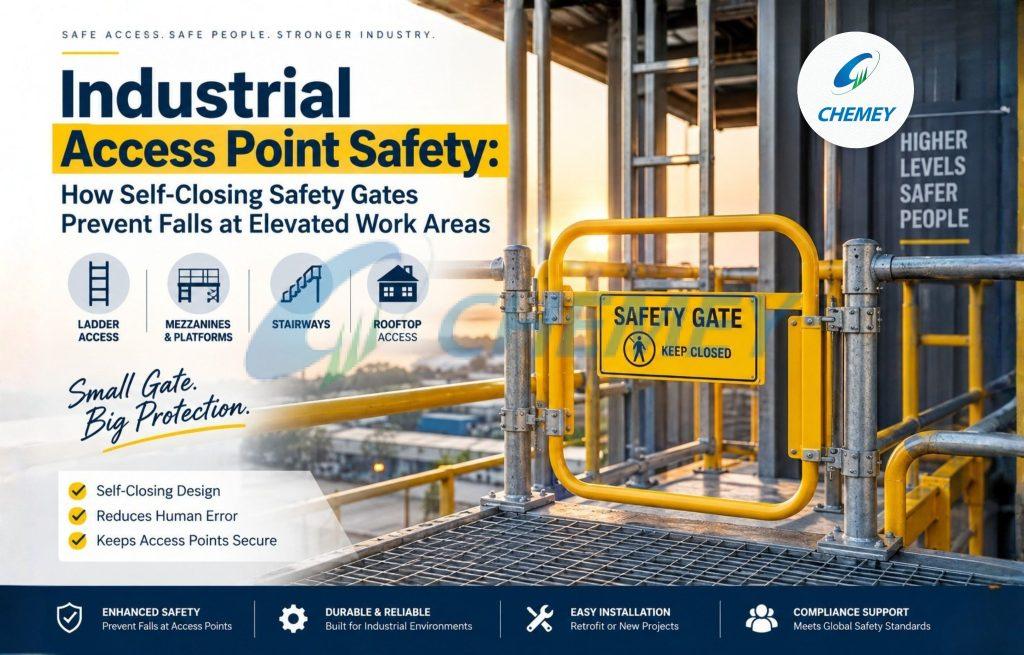
Industrial facilities are designed to move people, equipment and materials efficiently. But every access point between different levels can also introduce a fall hazard.
Ladders, mezzanines, platforms, elevated walkways, rooftop access points and maintenance areas often require workers to pass through openings in otherwise protected guardrail systems.
This creates an important engineering question:
“How can workers safely enter and exit an elevated area without leaving a permanent gap in fall protection?”
A properly specified self-closing industrial safety gate can provide a practical form of passive fall protection at these access points.
Unlike chains, removable bars or manually operated barriers, a self-closing gate is designed to return to the closed position after a person passes through.
What Is an Industrial Safety Gate?
An industrial safety gate is a protective gate installed at an opening in a guardrail, platform, ladderway, walkway or other elevated access area.
Its primary purpose is to maintain protection while still allowing authorized personnel to move through the access point.
Common applications include:
• Fixed ladder access
• Stairway openings
• Mezzanine platforms
• Elevated work platforms
• Rooftop access
• Maintenance platforms
• Industrial walkways
• Machinery access areas
• Restricted areas
The gate becomes part of the overall access-protection system rather than simply functioning as a physical door.
Why Are Access Points a Critical Fall-Protection Risk?
A continuous guardrail can protect an exposed edge effectively—but an opening is still required wherever people need to enter or exit.
For example:
Guardrail → Access Opening → Ladder → Lower Level
If the access opening is left unprotected, a worker approaching the ladder may be exposed to a fall hazard.
This is why access-point protection needs to be considered as part of the complete fall-protection design.
Self-Closing Safety Gates vs Manual Barriers
One of the biggest advantages of a self-closing gate is that it helps reduce dependence on worker memory.
Consider a conventional access opening protected by:
• A chain
• Removable pipe
• Manual barrier
• Swinging bar
• Temporary barricade
A worker may move the barrier and forget to replace it. That creates a new exposure.
A self-closing gate is designed to return to its closed position automatically.
Simple safety principle:
Open for access → Worker passes → Gate returns to closed position.
Where Should Industrial Safety Gates Be Used?
1. Fixed Ladder Access
Fixed ladders are common in manufacturing plants, warehouses, rooftops, process plants, utility areas and industrial maintenance zones.
2. Mezzanine Platforms
Mezzanines provide valuable additional floor space in warehouses and manufacturing facilities. Their exposed edges and access points require appropriate protection.
3. Elevated Work Platforms
Maintenance and production equipment often requires workers to operate from elevated platforms. Access openings may occur at stair entrances, ladder transitions, equipment access points and maintenance walkways.
4. Rooftop Access Points
Industrial rooftops increasingly contain HVAC equipment, solar installations, exhaust systems, electrical equipment and communication systems. Workers may need regular access for inspection and maintenance.
5. Industrial Walkways and Platforms
Industrial walkways often connect different operating areas. Where a walkway terminates at an elevated platform or equipment access point, a properly designed gate can help control movement and maintain protection.
What Are the Benefits of Self-Closing Safety Gates?
1. Passive Fall Protection
A self-closing gate provides protection without requiring the worker to manually replace a barrier after every passage.
2. Reduced Human-Error Risk
A self-closing mechanism is designed to return to the protected position automatically.
3. Easy Installation
Modular safety gates can be designed for quick installation using suitable clamping or mounting arrangements.
4. Retrofit Friendly
Industrial facilities often need to improve existing access points without replacing the entire guardrail system. Modular gates can be useful for plant upgrades and retrofit projects.
5. Customizable
Important factors can include opening width, mounting arrangement, gate height, pipe diameter, guardrail configuration, material and environmental conditions.
Safety Gate vs Guardrail: What’s the Difference?
A guardrail primarily protects an exposed edge or boundary.
A safety gate protects an opening within or adjacent to a guardrail while allowing controlled passage.
Therefore, they are not normally competing products.
They work together.
Guardrail = protects the edge
Safety gate = protects the access opening
This integrated approach creates a more continuous fall-protection system.
Safety Gate vs Chain or Removable Barrier
For frequently used access points, a permanently installed self-closing gate can offer operational advantages over temporary or manually replaced barriers.
Key comparison:
• Automatic closing: Self-closing gate — Yes, chain/removable barrier — usually no
• Continuous protection: Self-closing gate — better suited, chain/removable barrier — depends on user behaviour
• Frequent access: Self-closing gate — suitable, chain/removable barrier — can become inconvenient
• Human-error dependency: Self-closing gate — lower, chain/removable barrier — higher
• Retrofit potential: Both can be retrofit depending on application
The correct choice should always be based on the specific hazard, applicable regulations and facility operating conditions.
How to Choose the Right Industrial Safety Gate
Before specifying a safety gate, engineers and safety managers should evaluate several factors.
1. Measure the Clear Opening
Measure the rail-to-rail clear opening where the gate will be installed.
2. Identify the Access Type
Determine whether the gate is protecting ladder access, stair access, platform opening, rooftop access, walkway, machinery access or a restricted area.
3. Check the Existing Guardrail
Consider post diameter, post shape, guardrail height, available mounting space, opening width and gate swing direction.
4. Consider the Environment
Industrial environments can expose equipment to moisture, UV radiation, chemicals, dust, salt air and temperature changes. Material and finish should be selected according to the operating environment.
Engineering and Compliance Considerations
Safety gates should never be selected simply because they physically fit an opening.
The complete system should be evaluated against relevant regulations and engineering requirements. Requirements vary by country, facility type and application, so project teams should verify the applicable local regulations and standards before specification.
Compliance should be evaluated for the complete application—not just the gate itself.
The guardrail, gate, opening, platform, ladder and access arrangement should work together as one safety system.
Why Passive Protection Matters in Modern Industrial Safety
Modern safety engineering increasingly considers human factors alongside mechanical performance.
Workers may be under time pressure, carrying tools, performing repetitive maintenance, working in poor weather, moving between multiple access points or working around machinery.
A system that requires workers to remember every safety step can introduce operational vulnerabilities.
Passive systems attempt to make the safer behaviour the easier behaviour.
A self-closing safety gate is one example of this principle.
Where Safety Gates Fit Into a Complete Fall-Protection Strategy
A modern industrial facility may use several complementary safety systems:
Guardrails → Protect exposed edges
Safety Gates → Protect access openings
Walkways → Provide defined movement routes
Skylight Covers → Protect fragile roof openings
Lifelines → Provide personal fall protection where appropriate
Work Platforms → Provide safer access to equipment
The objective is not to install the maximum number of products. The objective is to create the right protection system for the actual risk.
Chemey Safety Gates for Industrial Applications
Chemey Mechatronics LLP provides engineered safety solutions including safety gates, safety railings, rooftop guardrails, walkways and other industrial access-protection systems.
Chemey’s safety-gate portfolio includes self-closing safety gates and pallet gates designed for different industrial access and opening-protection requirements.
For projects involving manufacturing plants, warehouses, PEB facilities, rooftops, mezzanines, elevated platforms and maintenance areas, an integrated access-safety assessment can help determine the appropriate solution.
Frequently Asked Questions
What is an industrial safety gate?
An industrial safety gate is a protective gate installed at an opening in a guardrail, platform, ladderway, walkway or elevated work area to help maintain fall protection while allowing controlled access.
Where are self-closing safety gates used?
They are commonly used at ladderways, stair openings, elevated platforms, mezzanines, rooftops, industrial walkways and other access points where an opening exists within a protected area.
Why should a safety gate be self-closing?
A self-closing mechanism automatically returns the gate toward the protected position after passage, reducing reliance on workers remembering to manually close a barrier.
Can safety gates be installed on existing guardrails?
Many modular safety gates are designed for retrofit applications, subject to the mounting requirements of the specific system and existing structure.
What is the difference between a safety gate and a guardrail?
A guardrail protects an exposed edge, while a safety gate provides controlled access through an opening in or associated with the guardrail. They are complementary components of an overall fall-protection system.
Can safety gates be used for rooftop access?
Yes. Safety gates can be used at designated rooftop access points where workers enter protected areas from ladders, stairs or other access systems. They should be integrated with the overall rooftop guardrail and access design.
What should I consider when selecting an industrial safety gate?
Consider the opening dimensions, mounting arrangement, guardrail configuration, access type, environmental conditions, required closing mechanism, applicable standards and long-term maintenance requirements.
Conclusion
An access point should never become a weak point in an industrial fall-protection system.
Guardrails can protect the perimeter, but workers still need to pass through designated openings to reach ladders, stairs, platforms and maintenance areas.
That is where self-closing industrial safety gates become an important engineering solution.
By automatically returning to the protected position, they can reduce dependence on manual actions while supporting safer movement through elevated access points.
For modern manufacturing plants, warehouses, PEB facilities, process industries, rooftops and maintenance platforms, the best approach is to consider guardrails, safety gates, walkways and other fall-protection systems as an integrated access-safety strategy.
Safe access is not simply about providing a way in – it is about ensuring that the way in remains protected.