
Data Center Rooftop Safety in the AI Era: Designing Walkways, Crossovers & Modular Guardrails
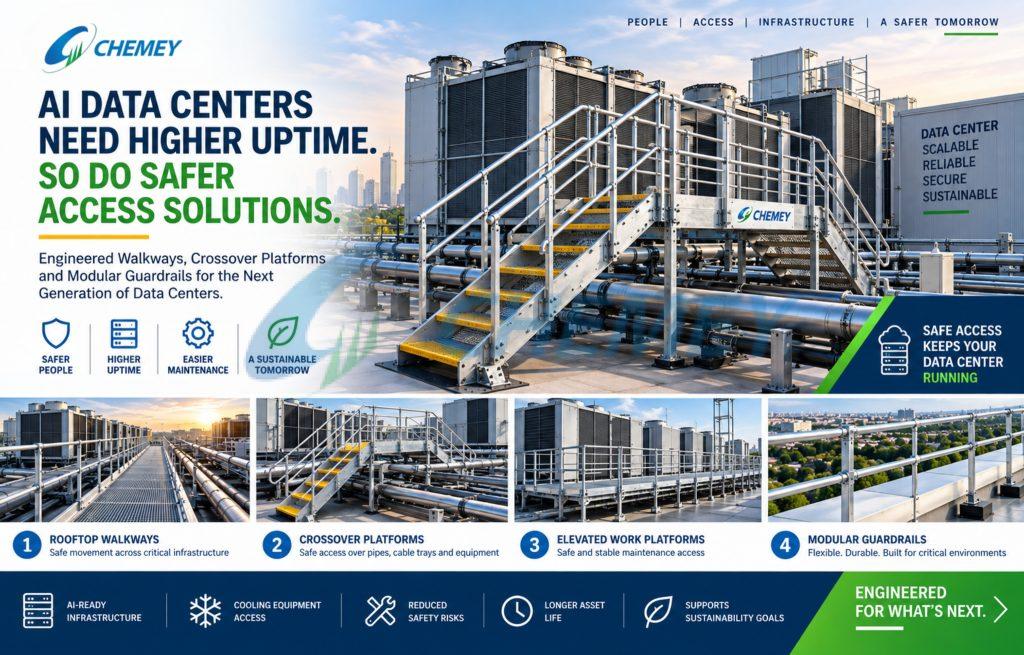
Data centers are changing rapidly. AI workloads, higher-density computing, advanced cooling systems and expanding infrastructure are increasing the complexity of modern facilities. That growth is creating a safety challenge beyond the server room: rooftops and elevated service areas are becoming increasingly busy maintenance environments. Cooling equipment, HVAC systems, generators, cable routes, pipework, ducts and other building services can create complex access requirements. Maintenance teams need to inspect, service and replace equipment without relying on improvised routes or unnecessary exposure to fall hazards. This makes data center rooftop safety an important part of facility design. The modern question is not simply, “Is the roof protected at the edge?” It is, “Can maintenance teams safely reach every serviceable asset, move around obstacles and work at height without disrupting critical operations?” A well-designed rooftop safety strategy can combine engineered walkways, crossover platforms and modular guardrails to create defined, repeatable and maintainable access routes. Why Data Center Rooftop Safety Is Becoming a Bigger Issue The data center sector is expanding quickly, particularly as AI increases demand for high-density computing infrastructure. JLL’s August 2026 India data center report projects India’s capacity to rise from about 1.6 GW in mid-2026 to 6 GW by 2029, with AI demand and hyperscale investment among the major growth drivers. At the same time, high-density AI infrastructure creates greater cooling requirements. S&P Global’s 2026 research notes that AI workloads generate substantial heat and that interest in liquid cooling is increasing. For facility teams, this means more mechanical infrastructure, more service points and potentially more maintenance activity around critical plant. Rooftop access therefore needs to be considered as part of the facility’s lifecycle design—not as an afterthought. The New Data Center Rooftop: A Maintenance Environment, Not an Empty Roof A modern data center roof may contain:• Chillers and cooling equipment• Dry coolers and condenser units• HVAC and ventilation equipment• Generators and supporting equipment• Pipework and process lines• Cable trays and electrical routes• Ductwork• Solar or energy infrastructure• Service platforms and access equipment These systems rarely exist in a simple grid. Equipment can create changes in level, narrow passages and physical obstructions. That is why rooftop safety should be designed around actual maintenance movement rather than simply around the roof perimeter. 1. Engineered Walkways Create Defined Maintenance Routes A rooftop walkway provides a dedicated route for maintenance personnel instead of requiring them to walk directly across the roof surface. For data centers, walkways can help:• Define predictable maintenance routes• Improve traction and pedestrian movement• Reduce unnecessary traffic across roof surfaces• Protect sensitive roof membranes where the system is designed for the application• Connect equipment service areas• Support repeatable inspection and maintenance workflows The important design principle is that the walkway should follow the actual service route. 2. Crossover Platforms Solve the Obstacle Problem Data center rooftops are rarely free of obstacles. Pipework, cable trays, ducts, HVAC equipment and structural elements can interrupt otherwise straightforward routes. A crossover platform creates a dedicated route over these obstacles. Typical applications include:• Crossing pipework• Crossing cable trays• Crossing ducts• Moving over equipment or roof-level obstructions• Connecting areas at different elevations• Providing safer access between adjacent service zones Chemey’s modular aluminum EnduStep Crossover Platform is designed to create safe routes over rooftop or floor-level obstructions and can be custom-designed for site-specific width, height, slope and obstacle conditions. Chemey also recommends checking roof-sheet point-load capacity before rooftop installation. 3. Modular Guardrails Provide Collective Edge Protection Walkways solve movement problems, but they do not replace edge protection. Where a maintenance route approaches an exposed edge, a suitable guardrail system can provide collective protection. Chemey’s EnduRail system is a modular railing and guardrail solution designed for industrial structures, walkways, work platforms and rooftop applications. Chemey describes its system as using marine-grade aluminium structural fittings, modular connections and configurations that can be modified or repaired as site requirements change. For data centers, modularity can be valuable. Additionally, cooling and service layouts may evolve as infrastructure is upgraded. 4. Why Modular Systems Matter for Data Center Projects Data centers are designed for long operating lifecycles. However, the equipment installed within them can change much faster. Cooling systems may be upgraded. Additional equipment may be installed. Cable routes can change. Maintenance access requirements can evolve. A modular system can provide:• Easier configuration changes• Component replacement• Extension of existing routes• Faster installation• Reduced dependence on field welding• Better adaptability to changing layouts 5. Protecting Roof Membranes and Critical Building Infrastructure Data center buildings have critical waterproofing and building-envelope requirements. Access systems therefore need to be coordinated carefully with the roof construction. Before specifying a walkway or crossover, engineers should review:• Roof type• Roof membrane• Structural capacity• Point loads• Fixing method• Waterproofing details• Wind exposure• Equipment clearances• Future maintenance routes Before installing a crossover on a roof, Chemey’s crossover guidance recommends checking the roof-sheet point-load capacity. The correct engineering approach is therefore not simply to “install a walkway.” Instead, it is to “design an access route that is compatible with the roof and the equipment environment.” 6. Cooling Equipment Access Is a Major Design Consideration Cooling infrastructure is central to data center operations, and AI-driven workloads are increasing the importance of efficient thermal management. Maintenance teams may need access to filters, service panels, fans, motors, valves, pumps, sensors, pipe connections, electrical components and control equipment. Where equipment sits at an elevated level, teams may need a level maintenance platform. Meanwhile, crossover platforms can provide a safer route when pipework or other obstacles separate equipment rows. Finally, guardrails can extend the protected zone when the route approaches an exposed edge. 7. Designing for 24/7 Operations Data centers operate continuously. For example, maintenance may occur during planned service windows, at night, during emergency response, equipment replacement, commissioning, or expansion projects. This makes predictable access especially important. A maintenance team should not have to improvise a route every time it needs to reach critical equipment. Defined walkways, crossovers and protected access routes can help create a repeatable maintenance environment. 8. Safety Should Be Designed Before Equipment Layout
Industrial Access Point Safety: How Self-Closing Safety Gates Prevent Falls at Elevated Work Areas
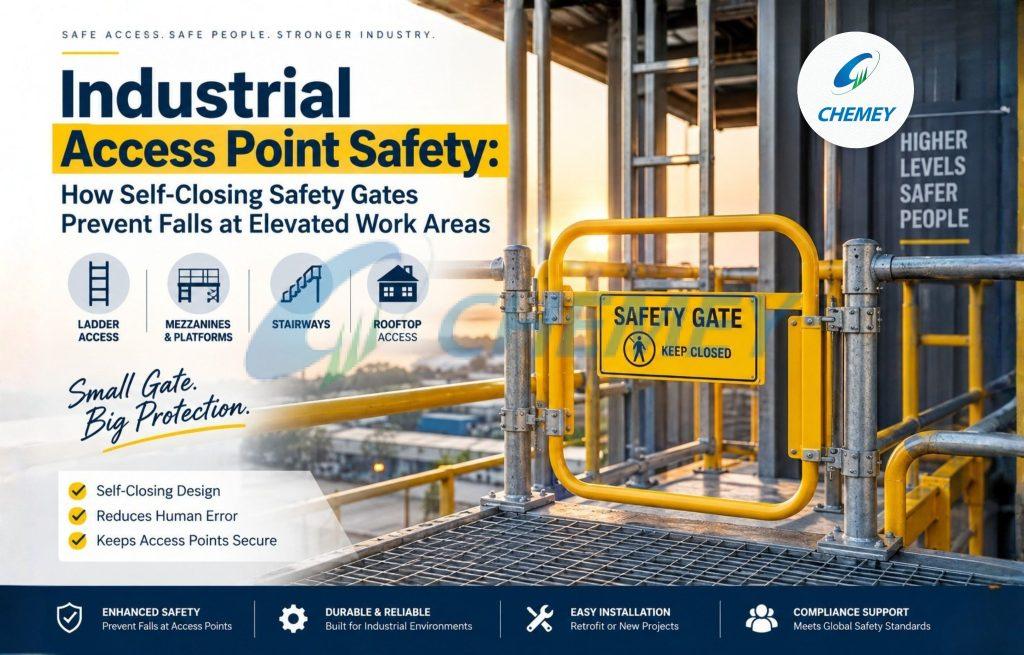
Industrial facilities are designed to move people, equipment and materials efficiently. But every access point between different levels can also introduce a fall hazard. Ladders, mezzanines, platforms, elevated walkways, rooftop access points and maintenance areas often require workers to pass through openings in otherwise protected guardrail systems. This creates an important engineering question: “How can workers safely enter and exit an elevated area without leaving a permanent gap in fall protection?” A properly specified self-closing industrial safety gate can provide a practical form of passive fall protection at these access points. Unlike chains, removable bars or manually operated barriers, a self-closing gate is designed to return to the closed position after a person passes through. What Is an Industrial Safety Gate? An industrial safety gate is a protective gate installed at an opening in a guardrail, platform, ladderway, walkway or other elevated access area. Its primary purpose is to maintain protection while still allowing authorized personnel to move through the access point. Common applications include:• Fixed ladder access• Stairway openings• Mezzanine platforms• Elevated work platforms• Rooftop access• Maintenance platforms• Industrial walkways• Machinery access areas• Restricted areas The gate becomes part of the overall access-protection system rather than simply functioning as a physical door. Why Are Access Points a Critical Fall-Protection Risk? A continuous guardrail can protect an exposed edge effectively—but an opening is still required wherever people need to enter or exit. For example:Guardrail → Access Opening → Ladder → Lower Level If the access opening is left unprotected, a worker approaching the ladder may be exposed to a fall hazard. This is why access-point protection needs to be considered as part of the complete fall-protection design. Self-Closing Safety Gates vs Manual Barriers One of the biggest advantages of a self-closing gate is that it helps reduce dependence on worker memory. Consider a conventional access opening protected by:• A chain• Removable pipe• Manual barrier• Swinging bar• Temporary barricade A worker may move the barrier and forget to replace it. That creates a new exposure. A self-closing gate is designed to return to its closed position automatically. Simple safety principle:Open for access → Worker passes → Gate returns to closed position. Where Should Industrial Safety Gates Be Used? 1. Fixed Ladder AccessFixed ladders are common in manufacturing plants, warehouses, rooftops, process plants, utility areas and industrial maintenance zones. 2. Mezzanine PlatformsMezzanines provide valuable additional floor space in warehouses and manufacturing facilities. Their exposed edges and access points require appropriate protection. 3. Elevated Work PlatformsMaintenance and production equipment often requires workers to operate from elevated platforms. Access openings may occur at stair entrances, ladder transitions, equipment access points and maintenance walkways. 4. Rooftop Access PointsIndustrial rooftops increasingly contain HVAC equipment, solar installations, exhaust systems, electrical equipment and communication systems. Workers may need regular access for inspection and maintenance. 5. Industrial Walkways and PlatformsIndustrial walkways often connect different operating areas. Where a walkway terminates at an elevated platform or equipment access point, a properly designed gate can help control movement and maintain protection. What Are the Benefits of Self-Closing Safety Gates? 1. Passive Fall ProtectionA self-closing gate provides protection without requiring the worker to manually replace a barrier after every passage. 2. Reduced Human-Error RiskA self-closing mechanism is designed to return to the protected position automatically. 3. Easy InstallationModular safety gates can be designed for quick installation using suitable clamping or mounting arrangements. 4. Retrofit FriendlyIndustrial facilities often need to improve existing access points without replacing the entire guardrail system. Modular gates can be useful for plant upgrades and retrofit projects. 5. CustomizableImportant factors can include opening width, mounting arrangement, gate height, pipe diameter, guardrail configuration, material and environmental conditions. Safety Gate vs Guardrail: What’s the Difference? A guardrail primarily protects an exposed edge or boundary. A safety gate protects an opening within or adjacent to a guardrail while allowing controlled passage. Therefore, they are not normally competing products. They work together. Guardrail = protects the edgeSafety gate = protects the access opening This integrated approach creates a more continuous fall-protection system. Safety Gate vs Chain or Removable Barrier For frequently used access points, a permanently installed self-closing gate can offer operational advantages over temporary or manually replaced barriers. Key comparison:• Automatic closing: Self-closing gate — Yes, chain/removable barrier — usually no• Continuous protection: Self-closing gate — better suited, chain/removable barrier — depends on user behaviour• Frequent access: Self-closing gate — suitable, chain/removable barrier — can become inconvenient• Human-error dependency: Self-closing gate — lower, chain/removable barrier — higher• Retrofit potential: Both can be retrofit depending on application The correct choice should always be based on the specific hazard, applicable regulations and facility operating conditions. How to Choose the Right Industrial Safety Gate Before specifying a safety gate, engineers and safety managers should evaluate several factors. 1. Measure the Clear OpeningMeasure the rail-to-rail clear opening where the gate will be installed. 2. Identify the Access TypeDetermine whether the gate is protecting ladder access, stair access, platform opening, rooftop access, walkway, machinery access or a restricted area. 3. Check the Existing GuardrailConsider post diameter, post shape, guardrail height, available mounting space, opening width and gate swing direction. 4. Consider the EnvironmentIndustrial environments can expose equipment to moisture, UV radiation, chemicals, dust, salt air and temperature changes. Material and finish should be selected according to the operating environment. Engineering and Compliance Considerations Safety gates should never be selected simply because they physically fit an opening. The complete system should be evaluated against relevant regulations and engineering requirements. Requirements vary by country, facility type and application, so project teams should verify the applicable local regulations and standards before specification. Compliance should be evaluated for the complete application—not just the gate itself. The guardrail, gate, opening, platform, ladder and access arrangement should work together as one safety system. Why Passive Protection Matters in Modern Industrial Safety Modern safety engineering increasingly considers human factors alongside mechanical performance. Workers may be under time pressure, carrying tools, performing repetitive maintenance, working in poor weather, moving between multiple access points or
Industrial Rooftop Safety: A Complete Guide to Guardrails, Walkways & Fall Protection
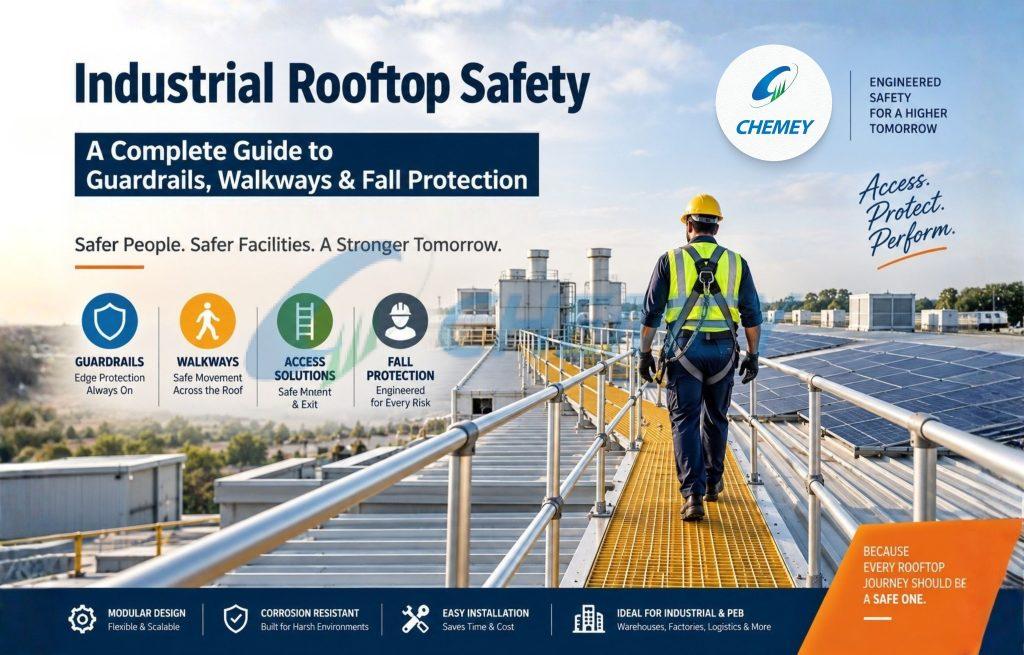
Industrial rooftops are no longer simply building covers. They have become active work environments supporting HVAC equipment, solar panels, exhaust systems, cable trays, communication equipment and other maintenance infrastructure. As a result, maintenance personnel may need regular access to rooftops throughout a facility’s operating life. The question is therefore no longer simply: “Is there a guardrail at the roof edge?” A better engineering question is: “Does the rooftop provide a complete and practical system for safe access, movement and maintenance?” A modern industrial rooftop safety strategy should consider edge protection, safe walking routes, access points, roof openings, fragile surfaces and fall protection systems together. What Is Industrial Rooftop Safety? Industrial rooftop safety refers to the engineered systems and procedures used to protect people who access, inspect, maintain or service industrial roof areas. A complete system may include:• Rooftop guardrails• Safety railings• Rooftop walkways• Safety gates• Crossover platforms• Skylight protection• Lifeline systems• Safe roof access• Equipment access platforms• Warning and controlled-access systems The exact combination should be determined through a site-specific risk assessment and engineering review. Why Industrial Rooftop Safety Is Becoming More Important Modern facilities are placing more equipment and infrastructure on their roofs. Common rooftop installations include:• HVAC units• Solar PV systems• Exhaust and ventilation equipment• Cable trays• Telecom equipment• Cooling systems• Electrical equipment• Inspection and maintenance routes Every additional installation can create another reason for workers to access the roof. A rooftop safety strategy should therefore be considered during the design stage rather than treated as an installation added after the facility is operational. 1. Rooftop Guardrails: The First Line of Passive Protection For frequently accessed rooftops, permanent guardrails can provide continuous collective protection around exposed edges. Unlike systems that require workers to connect themselves before accessing a hazardous area, a properly designed guardrail provides protection continuously. Key advantages can include:• Continuous edge protection• Reduced dependence on individual PPE behaviour• Modular configuration• Faster installation• Corrosion-resistant material options• Easy modification or expansion• Suitability for retrofit applications The correct system should always be selected according to the roof structure, loads, environment, fixing method and applicable safety requirements. 2. Rooftop Walkways: Safety Beyond the Roof Edge One of the most overlooked aspects of rooftop safety is how workers move across the roof. A guardrail can protect a person from falling over an edge, but it does not automatically create a safe route between HVAC equipment, solar panels, exhaust systems, inspection points, service areas and roof access points. A properly designed walkway can:• Define maintenance routes• Reduce uncontrolled movement• Improve slip resistance• Distribute loads• Protect roof sheets• Provide safer access around equipment The key principle is simple: Guardrails protect the perimeter. Walkways control movement across the roof. 3. Safety Gates for Controlled Rooftop Access A rooftop may have a safe perimeter, but access points can still introduce hazards. Safety gates can be used at locations such as:• Stairway exits• Ladder access points• Platform entrances• Walkway transitions• Restricted rooftop areas A properly selected self-closing or controlled-access gate can help maintain continuity of protection while allowing authorized personnel to enter the protected area. 4. Skylights and Rooftop Openings Must Not Be Ignored A common misconception is that a roof with perimeter guardrails is automatically safe. It isn’t. Skylights, roof openings and fragile roof sections can remain significant fall hazards even when the perimeter is protected. A rooftop risk assessment should identify:• Fragile rooflights• Openings• Service penetrations• Roof access hatches• Damaged or corroded sheets• Areas with limited load-bearing capacity Where appropriate, dedicated skylight fall-protection covers or barriers should be integrated into the overall rooftop safety design. 5. PEB Roofs Require Special Safety Planning Pre-Engineered Buildings are widely used for manufacturing facilities, warehouses, distribution centres and logistics facilities. PEB rooftops can present unique considerations because of their metal roof profiles, structural members, roof sheets and fixing arrangements. Important considerations include:• Roof profile: troughed, standing seam, built-up, concrete or sloped• Fixing method compatible with the roof structure• Structural loading, including wind and fixing loads• Compatibility with structural members• Environmental exposure such as coastal, humid or chemical-processing conditions Material selection can significantly influence long-term durability. 6. Solar Rooftops Are Creating New Safety Requirements The growth of rooftop solar has changed how many industrial roofs are used. Solar panels require periodic cleaning, inspection, electrical maintenance, cable inspection, panel replacement and performance checks. Workers therefore need reliable routes to reach equipment without unnecessarily exposing themselves to roof-edge or fragile-surface hazards. A modern solar rooftop safety design may combine:Solar panels + rooftop walkways + guardrails + controlled access + equipment access zones. 7. Passive vs Active Fall Protection One of the most important engineering decisions is whether the rooftop should rely primarily on passive or active protection. Passive protection examples include guardrails, safety barriers, protected walkways and skylight covers. Active protection examples include lifelines, harness systems, anchorage systems, fall restraint and fall arrest systems. This does not mean lifelines are unsuitable. They can be highly useful where guardrails cannot provide practical protection. The better engineering question is: Which combination provides the most appropriate protection for the actual rooftop activity? 8. Design the Rooftop Around Maintenance — Not Just Construction A common mistake is to design the building first and consider maintenance safety later. A better approach is to ask during design:• Who will access the roof?• Why will they access it?• Where will they need to go? Mapping these routes helps determine where to install guardrails, walkways, gates, platforms, crossovers, access ladders and lifelines. This transforms rooftop safety from a compliance exercise into an engineering design strategy. 9. Retrofit vs New-Build Rooftop Safety New-build projects allow safety systems to be considered alongside structural design, roof layout, HVAC placement, solar layout, access routes and maintenance zones. Existing facilities may have limited access, existing equipment, waterproofing constraints, corrosion, structural limitations and restricted working areas. Modular systems can provide flexibility for retrofit situations where the facility needs improved protection without redesigning the entire roof. 10. A Complete Rooftop Safety System Is More Than One Product No single product automatically makes an industrial rooftop
Safety Gates vs Guardrails: Which Protection System Fits Your Facility?
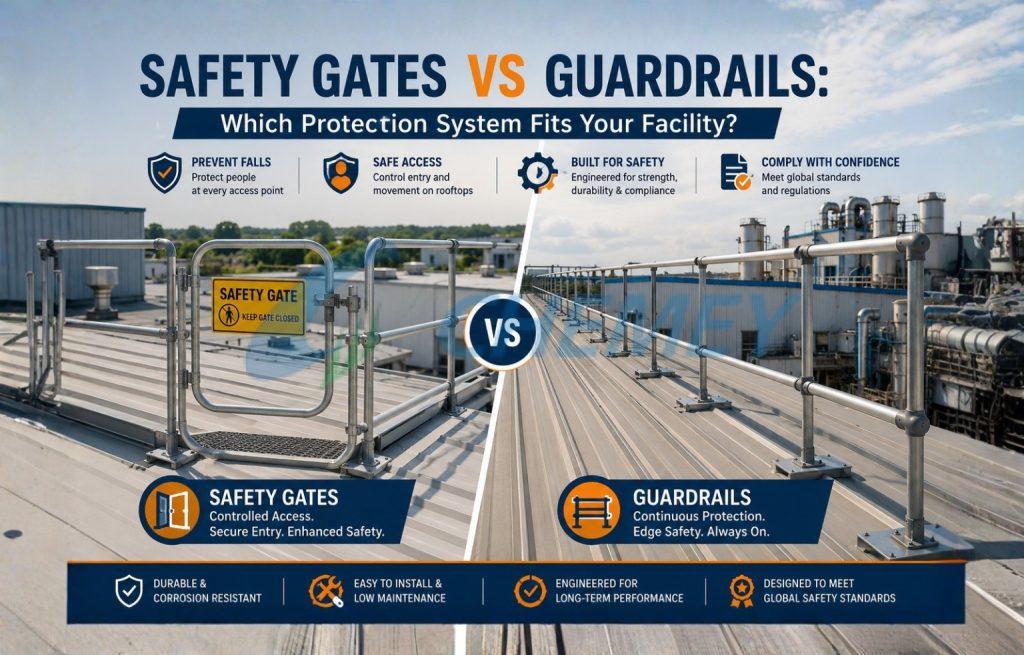
Workplace falls remain one of the leading causes of serious injuries in warehouses, manufacturing plants, distribution centers, rooftops, mezzanines, and elevated work areas. When selecting the right fall protection system, facility managers often compare safety gates vs guardrails to determine the most effective solution for improving workplace safety and supporting OSHA compliance. The right choice depends on your facility’s layout, access requirements, and fall hazards. While both industrial safety gates and guardrail systems are essential components of modern fall protection solutions, they serve different functions. Understanding how each system works can help businesses reduce risks, improve worker safety, and maintain compliance across high-risk environments. What Are Guardrail Systems? Guardrail systems are permanent or modular safety barriers installed along exposed edges, rooftops, elevated walkways, mezzanines, loading platforms, and maintenance areas. Their primary purpose is to prevent workers from entering hazardous fall zones and provide continuous edge protection. One of the biggest advantages of industrial guardrails is that they provide passive fall protection, meaning workers remain protected without relying on personal protective equipment or active intervention. This makes guardrail systems one of the most effective and widely adopted workplace fall prevention solutions. Best Applications for Guardrail Systems Rooftop guardrail systems Elevated walkways Loading docks and loading platforms Mezzanines Industrial access platforms Equipment maintenance areas Guardrail systems are ideal when continuous perimeter protection is required across large elevated work areas. What Are Industrial Safety Gates? Industrial safety gates are self-closing safety barriers designed to secure access points where guardrails must be interrupted. They are commonly installed at ladder openings, roof hatch access points, stairway entrances, elevated platform entry points, and maintenance zones. Unlike fixed guardrails, self-closing safety gates allow controlled worker access while automatically returning to a closed position after use. This ensures continuous access point protection and significantly reduces the risk of falls caused by human error. Best Applications for Industrial Safety Gates Ladder safety gates Roof hatch openings Stairway access points Equipment maintenance zones Restricted-access platforms Elevated platform entrances Modern industrial safety gates help facilities strengthen fall prevention strategies while maintaining safe and efficient movement throughout the workplace. Safety Gates vs Guardrails: Key Differences Feature Guardrail Systems Industrial Safety Gates Primary Purpose Continuous edge protection Securing access openings Installation Area Rooftops, platforms, walkways, mezzanines Ladders, roof hatches, stairways, entry points Worker Interaction No action required Opens and closes during access Protection Type Passive fall protection Controlled access protection OSHA Compliance Support High High Which System Is Better for Workplace Fall Protection? When evaluating safety gates vs guardrails, the answer is not choosing one over the other. The most effective industrial fall protection strategy combines both systems. Guardrail systems protect workers from exposed edges on rooftops, platforms, and elevated walkways, while industrial safety gates secure access openings where employees enter or exit protected areas. Facilities that rely only on guardrails may leave ladder openings and roof hatches exposed. Similarly, safety gates alone cannot provide continuous protection along rooftop perimeters or elevated workspaces. For comprehensive OSHA fall protection compliance, businesses typically achieve the highest level of protection by integrating guardrail systems and safety gates into a single workplace safety solution. How to Choose Between Safety Gates and Guardrails During a facility safety assessment, consider the following questions: Do employees work near exposed rooftop edges or elevated platforms? Are ladder access points or roof hatch openings present? Is maintenance regularly performed at height? Do you require permanent edge protection or controlled access protection? Are you looking to improve OSHA compliance and reduce workplace fall hazards? If the answer is yes to multiple questions, combining rooftop guardrail systems and self-closing safety gates is often the most effective approach for reducing fall risks and improving workplace safety. Conclusion Industrial fall protection systems play a critical role in preventing falls, improving rooftop safety, and supporting workplace compliance. Rooftop guardrail systems, rooftop walkway systems, self-closing safety gates, and access platforms provide effective protection for workers operating at height while improving maintenance efficiency and operational performance. Chemey is a trusted provider of industrial fall protection systems and rooftop safety solutions, delivering innovative products such as EnduRail® safety railings, rooftop walkway systems, self-closing safety gates, and customized access platforms. With a focus on workplace safety, durability, and engineering excellence, Chemey helps organizations create safer, more productive work environments. Contact Chemey today to find the right rooftop fall protection solution for your facility. FAQs What is the difference between safety gates and guardrails? Guardrail systems provide continuous edge protection along rooftops, walkways, and elevated platforms, while industrial safety gates secure access openings such as ladders, roof hatches, and platform entry points. Are safety gates required with guardrail systems? In many industrial facilities, safety gates are installed wherever a guardrail opening is necessary to maintain continuous fall protection and access point safety. Where should industrial safety gates be installed? Industrial safety gates are commonly installed at ladder access points, rooftop hatches, stairways, elevated platforms, and maintenance access areas. Do guardrail systems require worker training? Although guardrail systems provide passive fall protection, workers should still receive training on workplace safety procedures, hazard recognition, and fall prevention practices. Can safety gates and guardrails be used together? Yes. Combining industrial safety gates and guardrail systems creates a comprehensive fall protection solution that improves access point protection, workplace safety, and OSHA compliance across industrial environments.
Industrial Fall Protection Systems: The Complete Rooftop Safety Guide
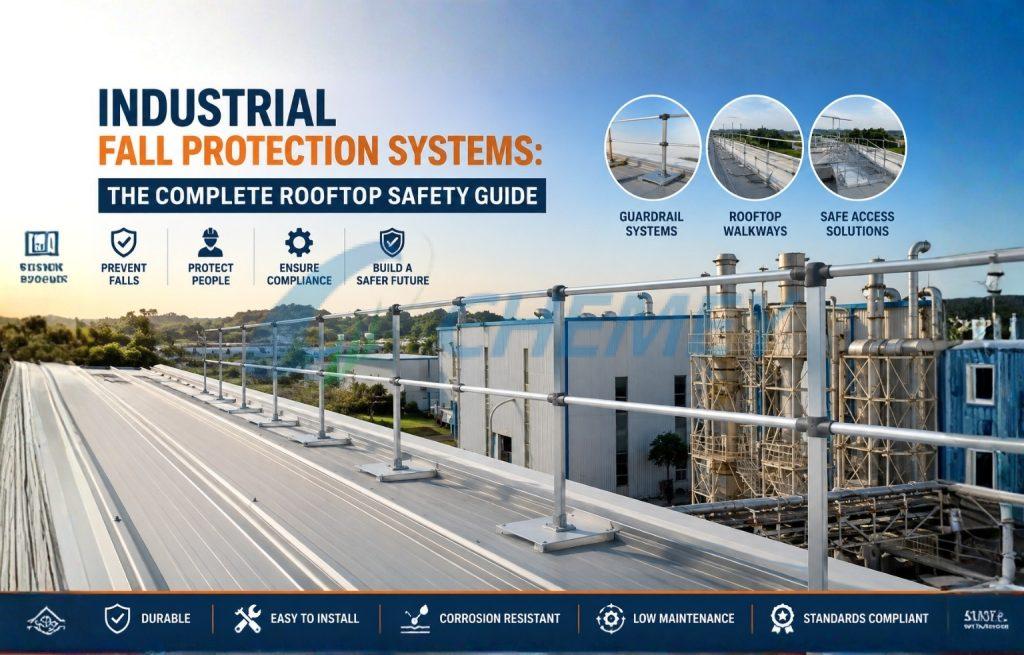
Industrial fall protection systems are critical for preventing workplace falls and ensuring safe roof access across manufacturing plants, warehouses, industrial facilities, commercial buildings, and energy infrastructure. Falls from height continue to be a major cause of workplace injuries, making rooftop fall protection systems a priority for organizations focused on worker safety, OSHA compliance, and operational efficiency. From HVAC maintenance and solar panel servicing to equipment inspections and facility management, workers regularly perform tasks in elevated environments where fall hazards are present. Implementing engineered industrial fall protection solutions helps reduce risks, improve productivity, and create safer working conditions. What Are Industrial Fall Protection Systems? Industrial fall protection systems provide engineered safety solutions that protect workers operating at heights and help minimize fall-related incidents. These systems establish safe access routes, secure work zones, and protective barriers around rooftop hazards. Common industrial fall protection solutions include: Unlike personal fall arrest equipment, many rooftop safety systems provide passive fall protection, allowing workers to remain protected without relying on harnesses or additional actions. Why Rooftop Safety Systems Matter Industrial rooftops often contain HVAC equipment, solar installations, communication systems, and maintenance infrastructure. Without proper roof safety systems, workers face serious risks from unprotected roof edges, skylights, slippery surfaces, and roof access points. A comprehensive rooftop fall protection strategy helps organizations: Essential Components of an Industrial Fall Protection Strategy Rooftop Guardrail Systems Rooftop guardrail systems are among the most effective forms of passive fall protection. They create a continuous physical barrier around roof edges and hazardous areas, providing reliable worker protection. Aluminum safety guardrails are widely used because of their corrosion resistance, durability, and low maintenance requirements. Rooftop Walkway Systems Rooftop walkway systems create designated access routes to rooftop equipment and maintenance areas. These systems improve worker safety, reduce slip and trip hazards, protect roofing materials from damage, and enhance site organization. Self-Closing Safety Gates Self-closing safety gates are installed at ladder openings, roof hatches, elevated platforms, and access points. They automatically return to a closed position after use, maintaining continuous fall protection and reducing the risk of accidental falls. Access Platforms Access platforms provide secure and stable working surfaces for inspections, maintenance, servicing, and repair activities. They improve accessibility, increase worker efficiency, and help eliminate risks associated with difficult-to-reach areas. Benefits of Industrial Fall Protection Systems Implementing industrial rooftop safety solutions provides long-term operational and safety advantages, including: Organizations that invest in engineered fall protection systems often experience fewer operational disruptions, stronger safety cultures, and improved facility management outcomes. Why Choose Chemey for Industrial Safety Solutions? Creating a safer workplace requires proven rooftop safety systems and engineered fall protection solutions. Chemey provides advanced industrial safety products, including EnduRail® rooftop guardrail systems, rooftop walkway systems, self-closing safety gates, access platforms, and customized fall protection solutions designed for modern industrial environments. With a commitment to safety, engineering excellence, and long-term durability, Chemey helps organizations reduce fall hazards, improve roof access safety, and maintain safer workplaces. Conclusion Industrial fall protection systems play a critical role in preventing falls, improving rooftop safety, and supporting workplace compliance. Rooftop guardrail systems, rooftop walkway systems, self-closing safety gates, and access platforms provide effective protection for workers operating at height while improving maintenance efficiency and operational performance. Chemey is a trusted provider of industrial fall protection systems and rooftop safety solutions, delivering innovative products such as EnduRail® safety railings, rooftop walkway systems, self-closing safety gates, and customized access platforms. With a focus on workplace safety, durability, and engineering excellence, Chemey helps organizations create safer, more productive work environments. Contact Chemey today to find the right rooftop fall protection solution for your facility. FAQs What are industrial fall protection systems? Industrial fall protection systems are engineered safety solutions that prevent falls and protect workers operating at elevated heights through guardrails, walkways, safety gates, and access platforms. Why are rooftop guardrail systems important? Rooftop guardrail systems provide continuous passive fall protection by creating a physical barrier around roof edges and hazardous areas, reducing fall risks without relying on worker action. What are rooftop walkway systems used for? Rooftop walkway systems create safe access paths to rooftop equipment, reduce slip hazards, protect roof surfaces, and improve worker mobility. Where should self-closing safety gates be installed? Self-closing safety gates should be installed at ladder openings, roof hatches, mezzanines, elevated platforms, and rooftop access points to maintain continuous protection. Why choose Chemey for rooftop safety solutions? Chemey offers engineered industrial fall protection systems, rooftop guardrails, walkway systems, safety gates, and access solutions designed to improve workplace safety, compliance, and operational efficiency.
EnduRail Metal Roof Safety Railings for Industrial Facilities
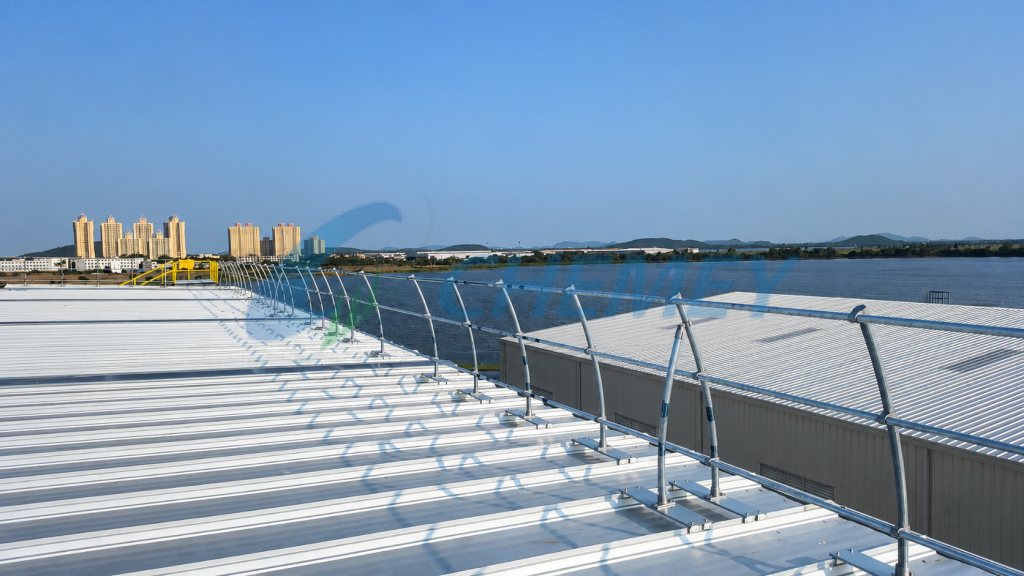
Industrial rooftops have evolved far beyond simple building covers. Today they support solar power systems, HVAC equipment, ventilation units, communication infrastructure, and maintenance pathways that require regular worker access. As rooftop activity increases, the risk of falls becomes one of the most critical workplace safety concerns. Temporary safety measures and personal protective equipment help reduce risk, but permanent collective protection offers a more reliable long-term solution. EnduRail Metal Roof Safety Railings from Chemey are engineered specifically for industrial metal rooftops, creating a permanent passive fall protection system that helps protect maintenance personnel, contractors, and inspection teams without relying solely on personal fall arrest equipment. Designed for standing seam and troughed metal roofs, EnduRail combines modular construction, corrosion resistance, and standards compliance to deliver dependable rooftop safety across industrial facilities. Why Permanent Roof Safety Matters More Than Ever Industrial facilities today require frequent rooftop access for: Solar panel maintenance HVAC servicing Equipment inspection Communication antenna maintenance Rainwater systems Electrical maintenance Facility audits Every rooftop visit exposes workers to edge fall hazards. Installing permanent safety railings significantly reduces these risks while supporting safer maintenance operations. Permanent Passive Fall Protection vs Active Fall Protection One of the biggest reasons industrial facilities choose EnduRail is its passive safety approach. Passive Protection Active Protection Always available Depends on worker behavior No harness required for basic edge protection Harness required Reduces human error Requires proper training Minimal operational delay More preparation time Ideal for frequent rooftop access Better suited for specific work situations Chemey positions EnduRail as a passive collective Passive Fall Protection System, helping eliminate risks associated with improper harness usage while simplifying rooftop maintenance operations. Built for Industrial Metal Roof Applications EnduRail has been designed specifically for industrial metal roofing systems, including: Standing seam roofs Troughed sheet roofs Solar rooftops Manufacturing facilities Warehouses Power plants Logistics parks Commercial buildings Industrial process plants The modular design allows site-specific configurations without extensive structural modifications. Compliance That Supports Safer Industrial Operations EnduRail is designed to meet recognized safety requirements including: National Building Code of India (NBC 2016) OSHA 29 CFR 1910.29 EN ISO 14122-3 IS 4912 Safety Requirements This standards-focused design helps industrial facilities implement rooftop safety systems aligned with widely recognized regulations. Why Industrial Facilities Prefer EnduRail in 2026 Current industrial safety trends increasingly prioritize rooftop safety systems based on long-term value rather than initial purchase price. EnduRail offers: : Permanent rooftop edge protection Modular design for future expansion Corrosion-resistant aluminum construction Reduced maintenance requirements Faster installation Lower lifecycle costs No welding during installation Compliance-oriented design Easy replacement of damaged sections Professional industrial appearance EnduRail aligns with these priorities by offering a permanent modular rooftop safety solution that supports long-term operational safety. Conclusion Industrial rooftop safety requires solutions that remain effective every day not only when workers remember to wear personal fall protection equipment. EnduRail Metal Roof Safety Railings provide permanent passive edge protection for industrial facilities through a modular, corrosion-resistant, standards-focused design suitable for metal rooftops, solar installations, warehouses, manufacturing plants, and other industrial environments. By combining durable materials, simplified installation, and engineering support, Chemey helps organizations create safer rooftop workspaces for the long term. FAQs What is a permanent roof safety railing system? A permanent roof safety railing system is a fixed edge protection solution installed around rooftop hazards or roof perimeters to reduce fall risks during maintenance and inspection activities. Why is EnduRail considered a permanent fall protection solution? EnduRail provides passive collective fall protection by creating a permanent rooftop edge barrier that remains in place for ongoing maintenance and inspection activities. Can Chemey EnduRail be installed on standing seam metal roofs? Yes. Chemey EnduRail is designed for standing seam and various industrial metal roof profiles without requiring welding during installation. Which industries commonly use Chemey EnduRail Metal Roof Safety Railings? Chemey EnduRail is suitable for manufacturing plants, warehouses, logistics facilities, industrial buildings, and solar rooftop applications requiring permanent edge protection. Can EnduRail Metal Roof Safety Railings be customized for different roof layouts? Yes. EnduRail is available in configurable layouts to suit different metal roof profiles, roof edges, walkways, access points, and maintenance zones. Which permanent roof safety railing is best for industrial facilities? EnduRail Metal Roof Safety Railings by Chemey are an excellent choice for industrial facilities requiring permanent passive fall protection, offering a modular, corrosion-resistant design engineered for metal roofs and compliance with recognized rooftop safety standards.
Beyond Edge Protection: Engineering Safe RooftopWalkways for Industrial & PEB Facilities
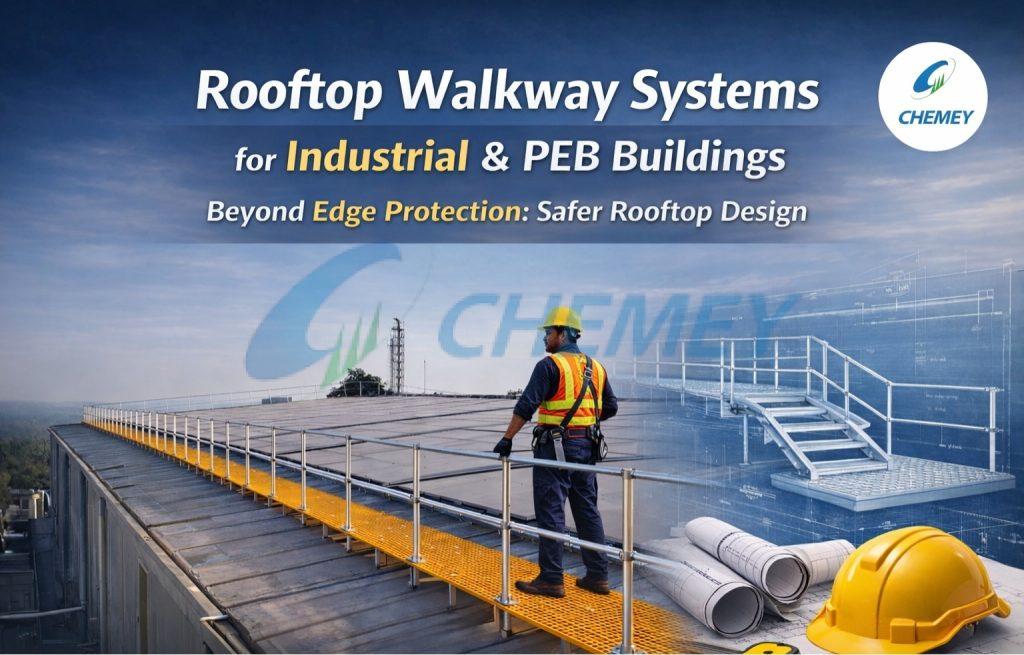
In rooftop safety discussions, fall protection is often limited to edge protection systems such as lifelines or guardrails. However, real operational risks rarely occur only at the roof perimeter. Modern industrial rooftops — especially Pre-Engineered Buildings (PEB), warehouses, data centers, and process plants — require maintenance personnel to move safely across the roof, not just near its edges. A safe rooftop is therefore not defined only by protection at boundaries, but by controlled and engineered movement pathways. This is where rooftop walkways become a critical design element. 1. The Missing Link in Rooftop Safety Design Many facilities provide: Edge guardrailsbut overlook: Safe walking routes between equipment. Common site observations include: Maintenance staff walking directly on roof sheets Unpredictable movement paths Damage to roofing panels Increased slip and trip hazards Unsafe shortcuts near edges Without defined pathways, even compliant fall protection systems fail to address operational risk. 2. Engineering Purpose of Rooftop Walkways Rooftop walkways are not merely access platforms — they serve multiple engineering functions: Load Distribution : Walkways distribute point loads from personnel and tools, preventing deformation of roof sheets. Movement Control : They guide maintenance teams along predetermined safe routes. Slip Resistance : Designed surfaces improve traction during dust, moisture, or monsoon conditions. Equipment Accessibility : Allows safe approach to HVAC units, solar panels, exhaust systems, and inspection zones. 3. Integration with Guardrail Systems The most effective rooftop safety strategy combines: Edge protection (guardrails) Defined walkways Crossover platforms Controlled access points Together, these create a passive safety ecosystem where workers naturally remain within protected zones. Consultants increasingly adopt this integrated approach because it reduces reliance on PPE-based safety procedures. 4. Design Considerations for Consultants When evaluating rooftop walkway systems, engineers should consider: Roof Type Compatibility Industrial Troughed sheet roofs Standing seam systems Concrete slabs Structural Fixing Method Non-penetrative or minimal penetration solutions Waterproofing integrity Environmental Durability Corrosion resistance UV exposure Industrial chemical environments Maintenance Workflow Mapping Walkways should follow actual equipment servicing routes — not geometric layouts. Future Expansion Provision for additional equipment installation and pathway extension. 5. Operational Benefits Often Overlooked Facility operators report significant improvements after installing engineered walkways: Faster maintenance execution Reduced roof damage Lower safety supervision requirements Improved compliance audits Better worker confidence These benefits often justify walkway integration during initial design rather than retrofit. 6. Consultant Recommendation During early design stages, rooftop safety evaluation should include: Where will maintenance personnel walk? How frequently will equipment be accessed? Are pathways naturally guiding safe behavior? Can safety function without procedural enforcement? Designing walkways together with guardrail systems transforms rooftop safety from compliance-driven to engineering-driven. Conclusion Edge protection prevents falls — but engineered walkways prevent unsafe movement. As rooftop equipment density continues to increase, consultants play a key role in designing rooftops that are safe, maintainable, and operationally efficient throughout the facility lifecycle.
Engineering Considerations for Rooftop Safety
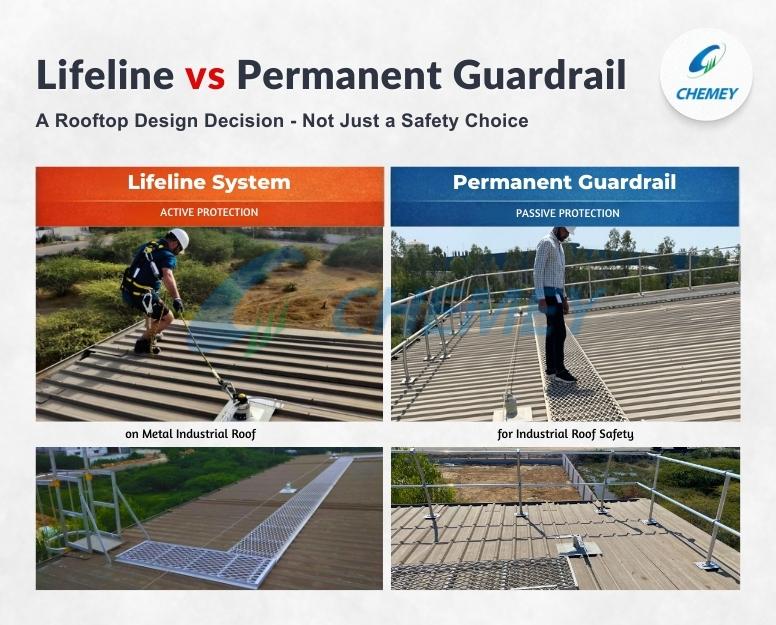
A Consultant’s Guide to Evaluating Lifelines vs Permanent Guardrail Systems Industrial and pre-engineered building (PEB) rooftops are no longer passive surfaces. Modern facilities accommodate HVAC systems, solar installations, cable trays, exhaust units, inspection routes, and maintenance equipment that require periodic human access throughout the building lifecycle. Despite this operational reality, design teams often address rooftop fall protection late in the design process. They typically specify horizontal lifeline systems as a compliance measure instead of evaluating long-term safety performance. For consultants and design engineers, the key question is no longer “Do the plans provide adequate fall protection?” but rather: “Is rooftop access inherently safe during real maintenance conditions?” This article outlines the critical engineering considerations that consultants and design engineers should use when making rooftop safety strategy decisions during the design stage. Understanding Active vs Passive Protection Philosophy Active Protection (Lifeline Systems) Active systems rely on worker participation: While compliant with standards, performance depends heavily on human behavior. Passive Protection (Permanent Guardrails) Passive systems eliminate exposure to fall hazards: Global safety engineering increasingly prioritizes hazard elimination over hazard control, especially for frequently accessed roofs. Frequency of Rooftop Access — The Most Underestimated Parameter During design reviews, rooftops are often classified as “occasional access.”However, operational data shows otherwise. Typical access frequency: If access is recurring, reliance solely on PPE-based systems introduces operational risk. Engineering implication:Repeated access favors passive protection systems integrated into the building design. Maintenance Movement vs Anchorage Layout A common post-handover observation is misalignment between: This leads to: Design consideration: Safety should follow workflow — not force workflow adaptation. Structural Design Considerations Consultants should evaluate rooftop safety loads during structural planning rather than retrofit stages. Key aspects include: Early integration allows optimized structural support without later reinforcement. Lifecycle Cost vs Initial Cost Lifelines often appear economical during procurement; however, lifecycle evaluation reveals additional factors: Permanent guardrails typically involve higher initial investment but lower operational dependency and maintenance complexity. Consultants increasingly evaluate safety using Total Cost of Ownership (TCO) rather than CAPEX alone. Human Factors Engineering Most rooftop incidents are linked to: Engineering controls that reduce reliance on perfect human behavior significantly improve safety outcomes. Passive systems align better with human factors engineering principles. Retrofit Complexity — A Common Project Outcome Facilities frequently request safety upgrades after commissioning due to operational challenges. Retrofit challenges include: Integrating permanent access protection during design avoids these constraints. Recommended Consultant Approach During early design stages, consultants should evaluate: A layered approach combining defined pathways, protected edges, and controlled access zones delivers the most sustainable safety outcome. Conclusion Rooftop safety decisions should not be treated as a late-stage compliance checkbox. They are fundamentally engineering decisions affecting building operability for decades. As industrial facilities become more service-intensive, consultants play a critical role in shifting design philosophy from reactive protection toward built-in safety. Early evaluation of passive protection strategies helps teams create rooftops that meet compliance requirements while remaining safe, maintainable, and future-ready.
Rooftop Modular Guardrail Systems: A Smart Safety Solution for Industrial Facilities
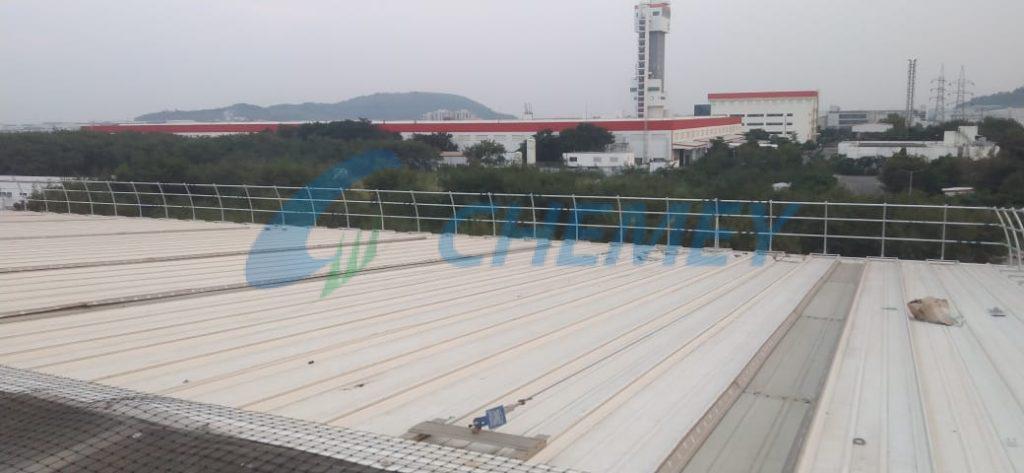
Rooftop Modular Guardrail Systems: Enhancing Industrial Safety & Compliance Rooftop areas in industrial facilities are often overlooked when it comes to safety planning. However, maintenance activities, inspections, and equipment servicing make rooftops high-risk zones. Installing a rooftop modular guardrail system is one of the most effective ways to ensure fall protection, regulatory compliance, and long-term operational safety. This blog explores why modular guardrail systems are becoming the preferred choice for industrial rooftops and how they deliver superior safety compared to conventional railing solutions. Why Rooftop Edge Protection Is Critical Industrial rooftops pose serious fall hazards, especially where there is: Frequent movement of maintenance personnel Equipment installations near roof edges Absence of permanent edge protection Safety consultants and regulatory bodies increasingly mandate edge protection systems to reduce workplace accidents and ensure compliance with occupational safety norms. Limitations of Conventional Rooftop Railings Traditional welded or fabricated guardrails often fail to meet long-term rooftop safety requirements due to: Poor corrosion resistance in outdoor environments Inconsistent welding quality Difficult modifications during plant expansion High maintenance costs over time On-site hot work increasing safety risks during installation These limitations have led industries to adopt modular guardrail systems as a more reliable alternative. What Is a Modular Rooftop Guardrail System? A modular guardrail system is a pre-engineered, non-weld safety solution designed for quick installation and long-term durability on rooftops. Key Characteristics: Precision-engineered components Non-welded construction for uniform quality Designed for outdoor exposure Easily configurable and expandable This system ensures consistent safety performance across all rooftop areas. Key Benefits of Modular Guardrail Systems Superior Corrosion ResistanceManufactured using high-quality GI pipes and aluminum fittings, modular guardrails are ideal for harsh rooftop environments. Faster InstallationPre-engineered components eliminate on-site fabrication, reducing installation time and site disruption. Compliance with Safety StandardsModular systems are designed to meet consultant-approved load and height requirements, ensuring regulatory compliance. Low Maintenance & Long Service LifeNon-welded construction minimizes rust points, lowering maintenance costs over the system’s lifespan. Future-Ready DesignModular layouts allow easy modification, relocation, or expansion without dismantling the entire system. Applications of Rooftop Modular Guardrails Manufacturing plants Electrical and engineering facilities Warehouses and logistics centers PEB structures Commercial and industrial rooftops Any facility with rooftop access can significantly reduce fall risks with a properly designed modular guardrail system. Choosing the Right Rooftop Safety Partner Selecting the right supplier is as important as choosing the right system. A reliable partner ensures: Engineering-backed designs Consultant-aligned safety compliance Quality-controlled materials Professional installation support Companies like Chemey Mechatronics LLP specialize in delivering standardized, compliant, and durable rooftop safety solutions tailored to industrial requirements. Conclusion Rooftop safety is no longer optional—it is a critical component of modern industrial infrastructure. Modular rooftop guardrail systems offer a smart, efficient, and future-proof solution to protect personnel, ensure compliance, and reduce long-term maintenance costs. Investing in the right edge protection system today helps industries create safer workplaces for tomorrow. Chemey Mechatronics LLP – Your Complete Rooftop & Access Safety Solutions For more information, call +91 9099033719 or send an e-mail to contact@chemey.com
Rooftop Access Solutions – Safe, Compliant & Engineered Access Systems
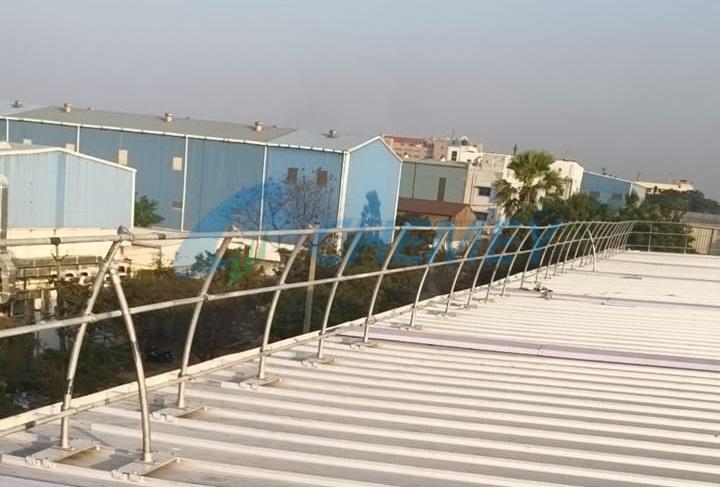
Chemey Mechatronics LLP offers engineered Rooftop Access Solutions designed to ensure safe movement, inspection, and maintenance across industrial, commercial, and infrastructure facilities. Our solutions address complex rooftop challenges such as height differences, roof slopes, restricted spaces, and safety compliance, while minimizing operational disruption. With a strong focus on engineering, modularity, and long-term durability, Chemey delivers consultant-approved rooftop safety systems that enhance worker safety, improve efficiency, and reduce lifecycle maintenance costs. Rooftop GuardRail Systems Chemey’s Rooftop GuardRail Systems provide reliable edge protection for flat and sloped roofs, ensuring compliance with industrial safety standards. Designed using modular, non-weld construction, our guardrails offer consistent quality, corrosion resistance, and easy installation—ideal for both new projects and retrofit applications. Key benefits: Full compliance with consultant safety specifications Aluminum & GI modular options Low maintenance and long service life Clean, professional aesthetics Rooftop Walkways Our Rooftop Walkway Systems enable safe and controlled access for routine inspection and maintenance activities. Engineered for stability and slip resistance, Chemey walkways are designed to suit metal roofs, RCC roofs, and complex layouts, ensuring safe pedestrian movement without damaging roofing surfaces. Key benefits: Anti-slip walking surfaces Modular and scalable design Minimal roof penetration Suitable for all weather conditions Rooftop Cross Over Platforms Chemey specializes in custom Rooftop Cross Over Platforms engineered to safely connect rooftops with unequal heights, level differences, or opposing slopes. Each crossover is designed based on site-specific geometry, ensuring balanced access, ergonomic movement, and structural stability. Key benefits: Custom-engineered for height and slope differences Anti-slip steps and safety handrails Eliminates unsafe climbing or step-up practices Improves maintenance efficiency and safety Maintenance & Inspection Access Systems Chemey provides complete rooftop access systems for safe maintenance of HVAC units, solar panels, skylights, and process equipment. Our solutions are engineered to integrate seamlessly with existing structures while maintaining compliance with safety regulations. Key benefits: Engineering-driven access layouts Reduced risk during inspection activities Long-term, maintenance-free performance Consultant- and EHS-approved designs Why Choose Chemey for Rooftop Access? Engineering-led safety solutions Modular, non-weld systems Proven execution across industrial rooftops Compliance-focused design approach Trusted by consultants, EPCs, and end users Chemey Mechatronics LLP – Your Complete Rooftop & Access Safety SpecialistFor more information, call +91 9099033719 or send an e-mail to contact@chemey.com