
A Consultant’s Guide to Evaluating Lifelines vs Permanent Guardrail Systems
Industrial and pre-engineered building (PEB) rooftops are no longer passive surfaces. Modern facilities accommodate HVAC systems, solar installations, cable trays, exhaust units, inspection routes, and maintenance equipment that require periodic human access throughout the building lifecycle.
Despite this operational reality, rooftop fall protection is often addressed late in the design process — typically by specifying horizontal lifeline systems as a compliance measure rather than evaluating long-term safety performance.
For consultants and design engineers, the key question is no longer “Is fall protection provided?” but rather:
“Is rooftop access inherently safe during real maintenance conditions?”
This article outlines the critical engineering considerations that should guide rooftop safety strategy decisions during design stages.
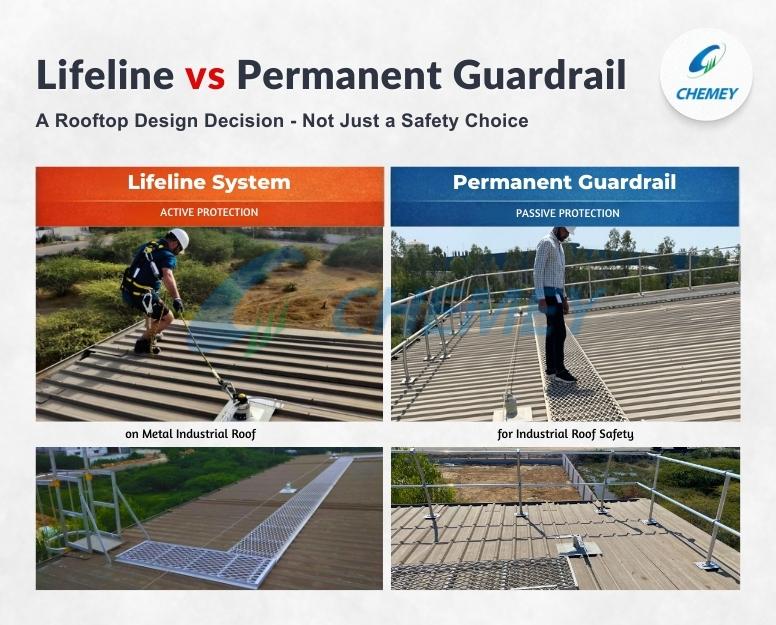
- Understanding Active vs Passive Protection Philosophy
Active Protection (Lifeline Systems)
Active systems rely on worker participation:
- Harness usage
- Proper anchorage connection
- Continuous attachment discipline
- Training and supervision
While compliant with standards, performance depends heavily on human behavior.
Passive Protection (Permanent Guardrails)
Passive systems eliminate exposure to fall hazards:
- No user action required
- Continuous edge protection
- Always active regardless of worker skill level
Global safety engineering increasingly prioritizes hazard elimination over hazard control, especially for frequently accessed roofs.
- Frequency of Rooftop Access — The Most Underestimated Parameter
During design reviews, rooftops are often classified as “occasional access.”
However, operational data shows otherwise.
Typical access frequency:
- HVAC inspection: monthly or quarterly
- Filter replacement: periodic
- Electrical and telecom servicing
- Solar maintenance
- Leak inspections during monsoon seasons
If access is recurring, reliance solely on PPE-based systems introduces operational risk.
Engineering implication:
Repeated access favors passive protection systems integrated into the building design.
- Maintenance Movement vs Anchorage Layout
A common post-handover observation is misalignment between:
- Natural walking paths of maintenance teams( Rooftop walkway)
- Installed lifeline anchorage positions
This leads to:
- Workers disconnecting temporarily
- Unsafe shortcuts near roof edges
- Reduced system usage over time
Design consideration:
- Define maintenance pathways early. ( Designed Rooftop walkway)
- Provide safe circulation routes, crossover platforms, and protected service zones.
Safety should follow workflow — not force workflow adaptation.
- Structural Design Considerations
Consultants should evaluate rooftop safety loads during structural planning rather than retrofit stages.
Key aspects include:
- Edge load capacity for guardrail systems
- Fixing methodology compatible with roof sheets or concrete slabs
- Wind load effects on elevated guardrails
- Corrosion resistance for coastal or chemical environments
- Compatibility with PEB structural members
Early integration allows optimized structural support without later reinforcement.
- Lifecycle Cost vs Initial Cost
Lifelines often appear economical during procurement; however, lifecycle evaluation reveals additional factors:
- Periodic inspection and recertification
- Replacement of damaged cables or anchors
- Training requirements
- Work delays due to attachment procedures
- Retrofit requests from facility operators
Permanent guardrails typically involve higher initial investment but lower operational dependency and maintenance complexity.
Consultants increasingly evaluate safety using Total Cost of Ownership (TCO) rather than CAPEX alone.
- Human Factors Engineering
Most rooftop incidents are linked to:
- Time pressure during maintenance
- Weather exposure
- Improper harness usage
- Fatigue or complacency
Engineering controls that reduce reliance on perfect human behavior significantly improve safety outcomes.
Passive systems align better with human factors engineering principles.
- Retrofit Complexity — A Common Project Outcome
Facilities frequently request safety upgrades after commissioning due to operational challenges.
Retrofit challenges include:
- Shutdown requirements
- Limited fixing access
- Structural modifications
- Waterproofing risks
- Increased installation cost
Integrating permanent access protection during design avoids these constraints.
- Recommended Consultant Approach
During early design stages, consultants should evaluate:
 Expected maintenance frequency Equipment density and layout Safe access routes and crossover needs Edge exposure zones Future expansion possibilities Compliance responsibility during building operation
A layered approach combining defined pathways, protected edges, and controlled access zones delivers the most sustainable safety outcome.
Conclusion
Rooftop safety decisions should not be treated as a late-stage compliance checkbox. They are fundamentally engineering decisions affecting building operability for decades.
As industrial facilities become more service-intensive, consultants play a critical role in shifting design philosophy from reactive protection toward built-in safety.
Early evaluation of passive protection strategies helps create rooftops that are not only compliant — but genuinely safe, maintainable, and future-ready.