
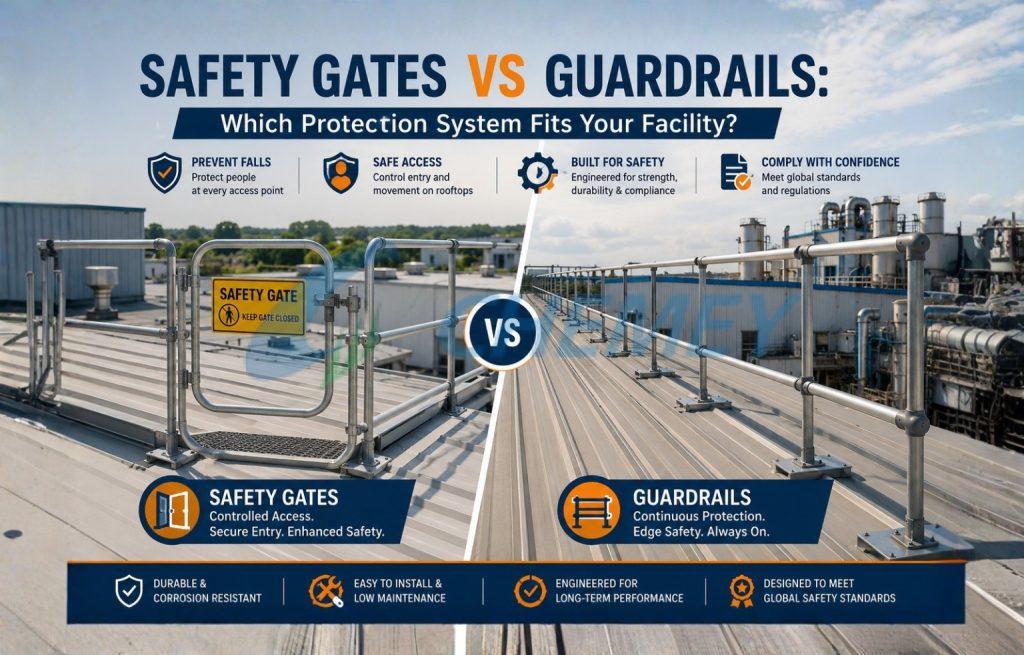
Workplace falls remain one of the leading causes of serious injuries in warehouses, manufacturing plants, distribution centers, rooftops, mezzanines, and elevated work areas. When selecting the right fall protection system, facility managers often compare safety gates vs guardrails to determine the most effective solution for improving workplace safety and supporting OSHA compliance.
The right choice depends on your facility’s layout, access requirements, and fall hazards. While both industrial safety gates and guardrail systems are essential components of modern fall protection solutions, they serve different functions. Understanding how each system works can help businesses reduce risks, improve worker safety, and maintain compliance across high-risk environments.
What Are Guardrail Systems?
Guardrail systems are permanent or modular safety barriers installed along exposed edges, rooftops, elevated walkways, mezzanines, loading platforms, and maintenance areas. Their primary purpose is to prevent workers from entering hazardous fall zones and provide continuous edge protection.
One of the biggest advantages of industrial guardrails is that they provide passive fall protection, meaning workers remain protected without relying on personal protective equipment or active intervention. This makes guardrail systems one of the most effective and widely adopted workplace fall prevention solutions.
Best Applications for Guardrail Systems
- Rooftop guardrail systems
- Elevated walkways
- Loading docks and loading platforms
- Mezzanines
- Industrial access platforms
- Equipment maintenance areas
Guardrail systems are ideal when continuous perimeter protection is required across large elevated work areas.
What Are Industrial Safety Gates?
Industrial safety gates are self-closing safety barriers designed to secure access points where guardrails must be interrupted. They are commonly installed at ladder openings, roof hatch access points, stairway entrances, elevated platform entry points, and maintenance zones.
Unlike fixed guardrails, self-closing safety gates allow controlled worker access while automatically returning to a closed position after use. This ensures continuous access point protection and significantly reduces the risk of falls caused by human error.
Best Applications for Industrial Safety Gates
- Ladder safety gates
- Roof hatch openings
- Stairway access points
- Equipment maintenance zones
- Restricted-access platforms
- Elevated platform entrances
Modern industrial safety gates help facilities strengthen fall prevention strategies while maintaining safe and efficient movement throughout the workplace.
Safety Gates vs Guardrails: Key Differences
|
Feature |
Guardrail Systems |
Industrial Safety Gates |
|
Primary Purpose |
Continuous edge protection |
Securing access openings |
|
Installation Area |
Rooftops, platforms, walkways, mezzanines |
Ladders, roof hatches, stairways, entry points |
|
Worker Interaction |
No action required |
Opens and closes during access |
|
Protection Type |
Passive fall protection |
Controlled access protection |
|
OSHA Compliance Support |
High |
High |
Which System Is Better for Workplace Fall Protection?
When evaluating safety gates vs guardrails, the answer is not choosing one over the other. The most effective industrial fall protection strategy combines both systems.
Guardrail systems protect workers from exposed edges on rooftops, platforms, and elevated walkways, while industrial safety gates secure access openings where employees enter or exit protected areas. Facilities that rely only on guardrails may leave ladder openings and roof hatches exposed. Similarly, safety gates alone cannot provide continuous protection along rooftop perimeters or elevated workspaces.
For comprehensive OSHA fall protection compliance, businesses typically achieve the highest level of protection by integrating guardrail systems and safety gates into a single workplace safety solution.
How to Choose Between Safety Gates and Guardrails
During a facility safety assessment, consider the following questions:
- Do employees work near exposed rooftop edges or elevated platforms?
- Are ladder access points or roof hatch openings present?
- Is maintenance regularly performed at height?
- Do you require permanent edge protection or controlled access protection?
- Are you looking to improve OSHA compliance and reduce workplace fall hazards?
If the answer is yes to multiple questions, combining rooftop guardrail systems and self-closing safety gates is often the most effective approach for reducing fall risks and improving workplace safety.
Conclusion
Industrial fall protection systems play a critical role in preventing falls, improving rooftop safety, and supporting workplace compliance. Rooftop guardrail systems, rooftop walkway systems, self-closing safety gates, and access platforms provide effective protection for workers operating at height while improving maintenance efficiency and operational performance.
Chemey is a trusted provider of industrial fall protection systems and rooftop safety solutions, delivering innovative products such as EnduRail® safety railings, rooftop walkway systems, self-closing safety gates, and customized access platforms. With a focus on workplace safety, durability, and engineering excellence, Chemey helps organizations create safer, more productive work environments. Contact Chemey today to find the right rooftop fall protection solution for your facility.
FAQs
What is the difference between safety gates and guardrails?
Guardrail systems provide continuous edge protection along rooftops, walkways, and elevated platforms, while industrial safety gates secure access openings such as ladders, roof hatches, and platform entry points.
Are safety gates required with guardrail systems?
In many industrial facilities, safety gates are installed wherever a guardrail opening is necessary to maintain continuous fall protection and access point safety.
Where should industrial safety gates be installed?
Industrial safety gates are commonly installed at ladder access points, rooftop hatches, stairways, elevated platforms, and maintenance access areas.
Do guardrail systems require worker training?
Although guardrail systems provide passive fall protection, workers should still receive training on workplace safety procedures, hazard recognition, and fall prevention practices.
Can safety gates and guardrails be used together?
Yes. Combining industrial safety gates and guardrail systems creates a comprehensive fall protection solution that improves access point protection, workplace safety, and OSHA compliance across industrial environments.