
Fall Protection Free Videos available from OSHA

OSHA has many safety videos that are available from their library for free. Here is a listing of the videos that are available for the Fall Protection category. Take advantage of these resources if you can: https://www.youtube.com/watch?v=Qpowg5Ynh0whttps://www.youtube.com/watch?v=UYMb1XZ83zQhttps://www.youtube.com/watch?v=_2YFDJCXM74https://www.youtube.com/watch?v=-_HCde2jI34https://www.youtube.com/watch?v=kRUywsBpWY8&feature=emb_rel_endhttps://www.youtube.com/watch?v=T43u0i8bQ34https://www.youtube.com/watch?v=XSfkJqtE8Dk
Separating People from Hazards is key to Safety
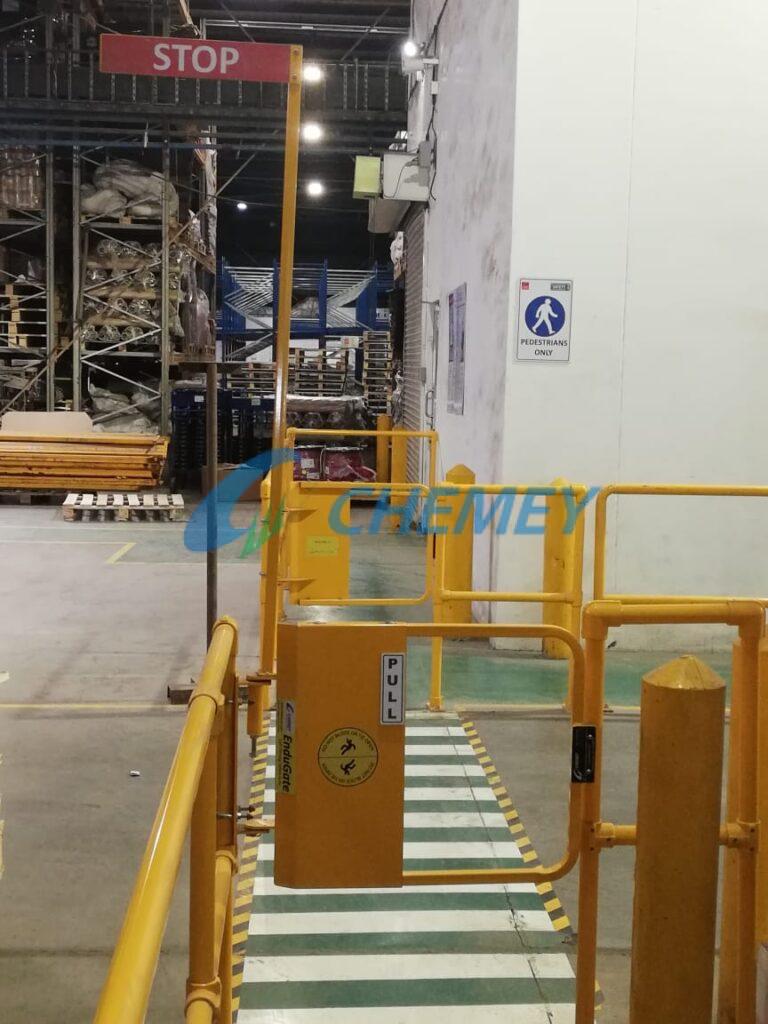
‘BS EN 14122-3 Safety Machinery – Permanent means of access to machinery’ outlines the general requirements for safe access to machines where a fixed means of access and barricade is needed. Continuous rotating and heavy machinery working environments possess potential hazards that workers face in industrial surroundings on a daily basis. Managers should consider these hazards and install necessary barricades and safety swing gates to eliminate serious injuries and fatalities. Avoiding accidents around machinery The most effective way to ensure that workers and vehicles can move safely around the workplace is to provide a safe demarcated route for the workers to walk along, with protective barriers and guardrails. These systems can provide a safe route within an area where vehicles are working or prevent access to a specific area. By combining spring loaded self-closing gates with the barrier or guardrail, workers are made aware that they are leaving a safe area when they pass through the gate. Preventing falls from height If a ladder is being used to access the machinery, then a safety solution needs to be in place, and we would recommend using a self-closing safety gate. These gates overcome the risk of human error that’s associated with chains and sliding tubes as they automatically close behind the user.
Why you must separate pedestrians and vehicles in Industry & Logistic Area
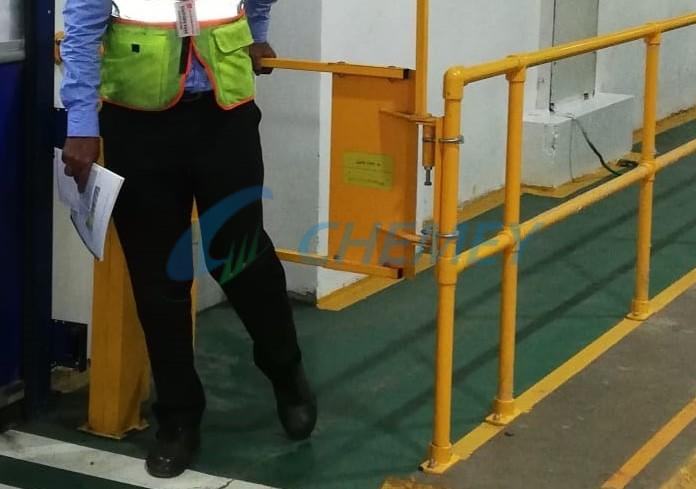
ACCIDENTS FROM OPERATING FORKLIFTS NOT ONLY CAN CAUSE PHYSICAL DAMAGE AND PERSONNEL INJURIES OR FATALITIES, BUT THEY ALSO CAN LEAD TO SUBSTANTIAL FINANCIAL LOSS FOR COMPANIES. A company may face Factory and Labor laws consequences after a worker get hit by a fork lift truck and suffered serious injuries. In area where fork lift trucks move loads while pedestrians freely walked around the area and in between the trucks, The HSE inspector knows that: “Workplace transport incidents are the third highest cause of workplace fatalities, and accidents can be prevented if companies implement simple control measures. The need to walk through area should me clearly foreseeable and Risk from vehicle traffic should be isolated. Where there is regular vehicle traffic such as in warehouses, loading bays, yards and logistics centers, pedestrians or vehicles must be able to use a designated traffic route without causing danger to safety of people working near it. An effective way to Separate vehicles and pedestrians separate is through Protective Hard barriers, Single side Openable safety gates and Guardrails. EnduRail® Modular Handrail, EnduGate and FlexiCade® Barriers are ideal solution for separating pedestrians and vehicles. The flexibility of EnduRail® fittings allows the design of a barrier system to accommodate changes in angles as well as different levels. Spring loaded self-closing safety gates can provide additional protection with the barrier or guardrail systems as users area made aware that they are leaving a safe area as they pass through the safety gate. A further benefit of using EnduRail fittings to construct barriers and guardrails is that, if the system is struck by a vehicle, it can be quickly and easily repaired by replacing the damaged fittings and tube. All barrier systems are available in High visibility “Safety Yellow” powder coating.
Basic Overview of Working and Walking Surfaces
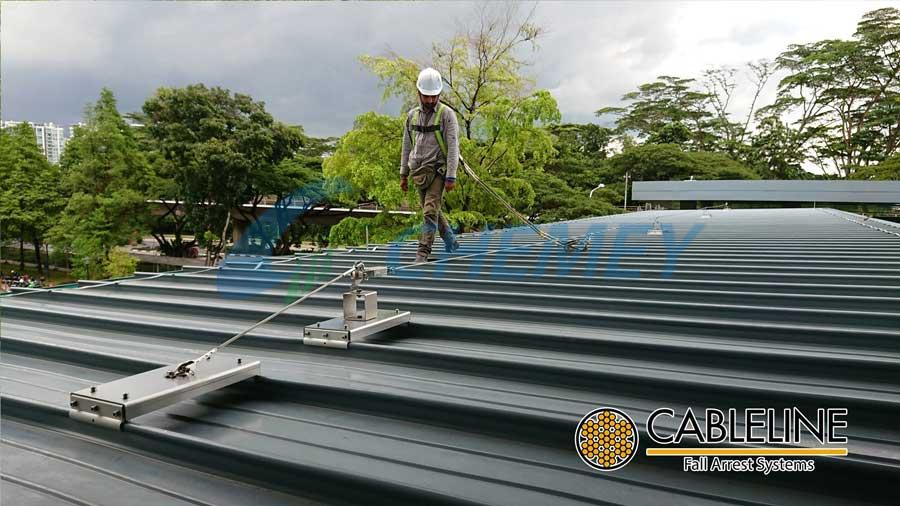
The following information is a general overview of major points and standards according to OSHA 29 CFR Part 1910, Walking and Working Surfaces for General Industry. Key Terms: Floor Hole: opening less than 12 inches but more than 1 inch Floor Opening: an opening greater than 12 inches where a person may fall Toe board: barrier to prevent the falling of materials Standard Railing: barrier to prevent persons from falling Wall Hole: an opening less than 30 inches but more than 1 inch high of unrestricted width, in any wall or partition Wall Opening: an opening greater than 30 inches high and 18 inches wide General Requirements: All places of employment, passageways, storerooms, and service rooms shall be kept clean and orderly and in a sanitary condition Aisles and passageways shall be kept clear and in good repairs, with no obstruction across or in aisles that could create a hazard Covers and/or guardrails provided to protect personnel from the hazards of open pits, tanks, vats, ditches, etc. Load rating limits shall be posted on all cover plates Floor Openings, Wall Openings, and Holes: Railings to be provided on all exposed sides of a stairway except entrance Guardrails to be in place or attendant posted at all temporary floor openings Floor holes to have standard railing with toe board or hole cover of standard strength and construction Every hatchway or chute opening to be guarded Platforms 4 feet or more above ground shall be guarded by standard railing on all open sides except entrance to ramp, stairway, or fixed ladder Railing, Toe board, and Cover Specifications: Top rails shall have a vertical height of 42 inches nominal from upper surface of top rail to floor Protection between top rail and floor, platform, runway, ramp, or stair treads, equivalent at least to that afforded by a standard intermediate rail Height of handrails shall be not more than 34 inches nor less than 30 inches from upper surface of handrail to surface of tread Toe board should be nominal 4 inches in vertical height Roadway manhole covers to handle at least 20,000 pounds Skylight screens must be able to carry at least 200 pounds 200 pounds for wall opening covers Stairways: Every flight of stairs with 4 or more risers shall have standard railings or handrails Stairways less than 44 inches wide having both sides enclosed, must have at least one fixed handrail Less than 44 inches wide with open side, one affixed handrail on open side Less than 44 inches wide with two open sides, two handrails to be provided on each side Fixed industrial stairs are to carry 5 times anticipated load Minimum moving concentrated load of 1000 pounds Minimum width of 22 inches Angle to horizontal between 30 and 50 degrees Vertical clearance from tread to overhead a minimum of 7 feet Scaffold and ladder: Mostly use scaffold of appropriate size platform and load capacity Must extend at least 3 feet above point of support Never to be placed near electrical hazards Secure positions/footing, or lashed or held in position Never splice ladders to elongate Never use ladder as platforms
Putting railing around Freshwater, Wastewater, or Sea Water (Saline water) present itself with several challenges.
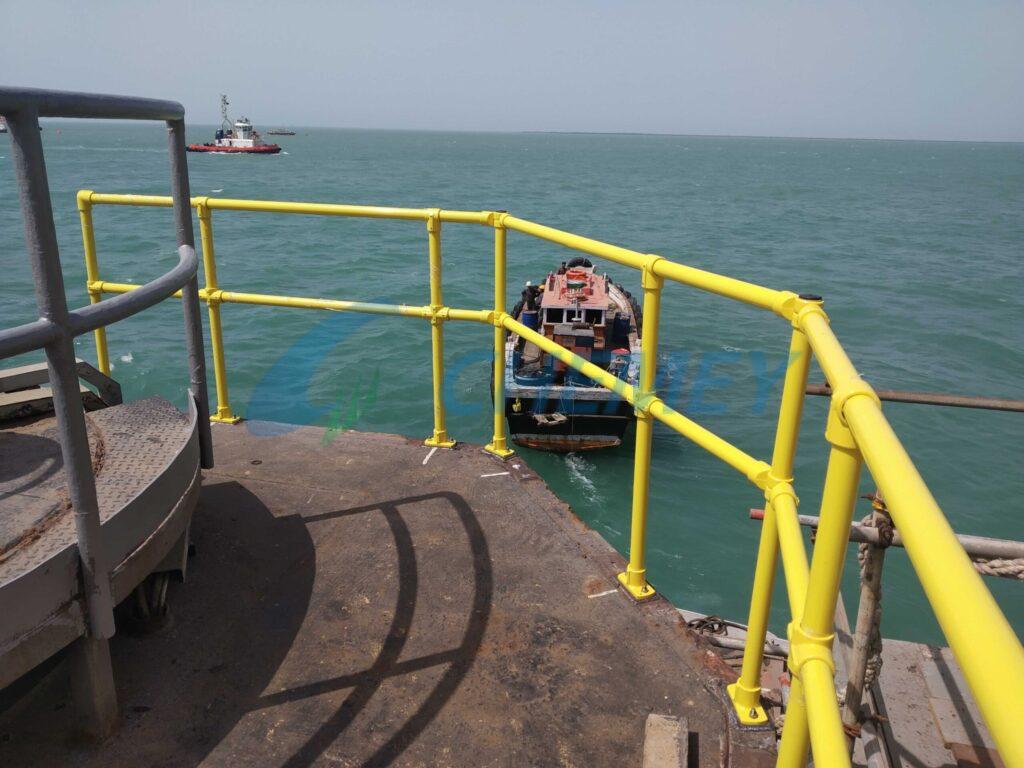
First, you have the fact that there is water everywhere, and water and metal don’t have good chemistry. In addition to the water-rich environment, you have the added challenge of construction difficulties. If you are installing railing on a walkway around water, you might only be able to get access from one side. To further complicate matters, in the water industry or jetty you often have complex pieces of machinery that need to be protected, making for complicated paths for the railing to get around the equipment. Finally, moreover, you usually need to add a toe board or kick plate to keep things from being kicked into water. Installing a railing around water can be a complicated process. Making it Easier and More Cost-Effective Here at Chemey Techsolutions LLP we utilize EnduRail® Structural railing fittings to design aluminium railings that meet the complex challenges of installing a railing in water-rich environments. To start with, the fittings and pipe are designed to resist corrosion, All Aluminum. No welding means a simpler, faster and more cost-effective installation. When using pre-coated steel pipe, the protective coating of the railing is not damaged in the installation process. This makes the railing last much longer when exposed to water. In most cases, a few simple tools and a drill is all that is required to complete the installation. Most installations can be completed by in-house maintenance staff, rather than higher-priced technical labour. Even in the case where you need to outsource installation, the simple method requires only standard contractors, rather than specialized labour. The simplicity of installation also means that the railing will be ready faster. Getting around complex machinery is as simple as finding the right fittings and cutting the pipe to length. No need for complex pipe bends! The fittings come in many different angles to help get your railing into those difficult locations. Toeboard and kick plate is much easier. Using a newly designed toe plate, it can be attached to post/upright with simple channel nut, without welding. Hopefully, this review demonstrates why railings built with EnduRail fittings are superior to install against a welded handrail. Our sales engineers will be glad to help provide you with assistance when specifying or acquiring the necessary equipment to install a handrail. Find out more about our OSHA compliant railings and products that apply to the Industrial Safety & Municipal and Water Industries. Need help? Our team of professionals can guide you to find the ideal solution. We are there for you 24/7! Just call us on +91 79-26420786, +91 9099033711, +91 79-26427686 or email us: contact@chemey.com | Contact Us ollow us on Facebook | Instagram | Linkedin | Twitter
Inspect Your Railing for Rust to Ensure Proper Fall Protection
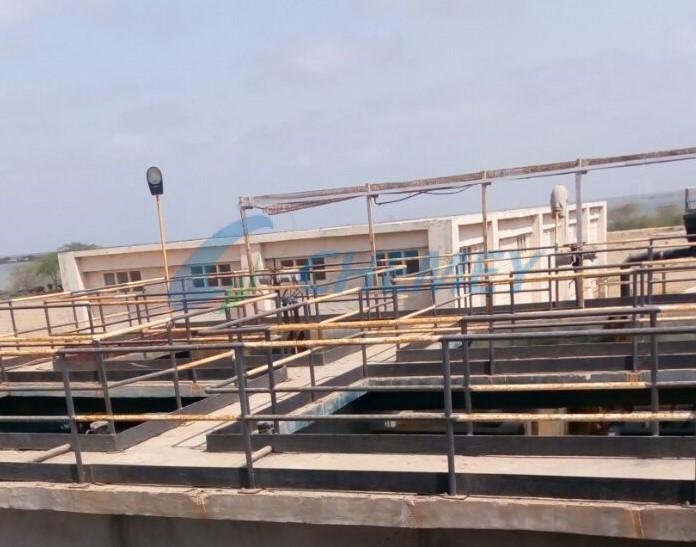
Metal and particularly MS Railing rusting is more than just a visual problem. Rust is the cancer of the MS metal world. It eats away at the material from the inside. Many railing manufacturers just paint the railings without galvanizing. The result is a product that rusts after a few years of use. Rusted railing is not just an eye sore; it is unsafe. When metal is rusted it loses it structural integrity, resulting in a product that will not perform to manufactures specification. In short, if your railing is rusted and someone falls into the railing, both the railing and the person will fall off the platform or roof. Inspection To assure a safe environment while working at heights, be sure to annually inspect railings for rust. Pay attention to the joints where welds are made. If the joint is rusty, it may no longer be structural. Prevention The best way to prevent rust is to invest in a railing product that has proper material of construction. Avoid railing that is welded. Even if your MS railing pipe is galvanized, welding requires that the galvanization be removed. Most of the time on a welded railing, the joints begin to rust long before the main sections of pipe. To avoid welding, build a railing based on – Aluminum Structural Fittings. Fittings provide a connection as strong as a weld, but the galvanization is not broken, resulting in a longer lasting railing. • Build with aluminum. Aluminum is great for moisture rich environments. It will not rust, and it provides a great look. You’ll pay extra for aluminum, but if you are looking to the long term the results will be worth the cost. • Add Anodising for an added level of protection. When all aluminum railing is built, protect it with anodized to increase corrosion resistance and to allow dyeing (coloring) it Also adds longevity and aesthetic value to the railing. • Add powder coating for an added level of protection. Standard paint usually chips off easily. Powder coating is a baked-on paint that provides a protective coating over the entire surface of the metal. Powder coating can usually be done in any RAL color and adds longevity and aesthetic value to the railing. If MS pipes are used,be sure that the metal underneath is galvanized to prevent rusting if the paint coating should chip.
Advantages Aluminum Scaffolding Has To Offer Over Steel Scaffolding
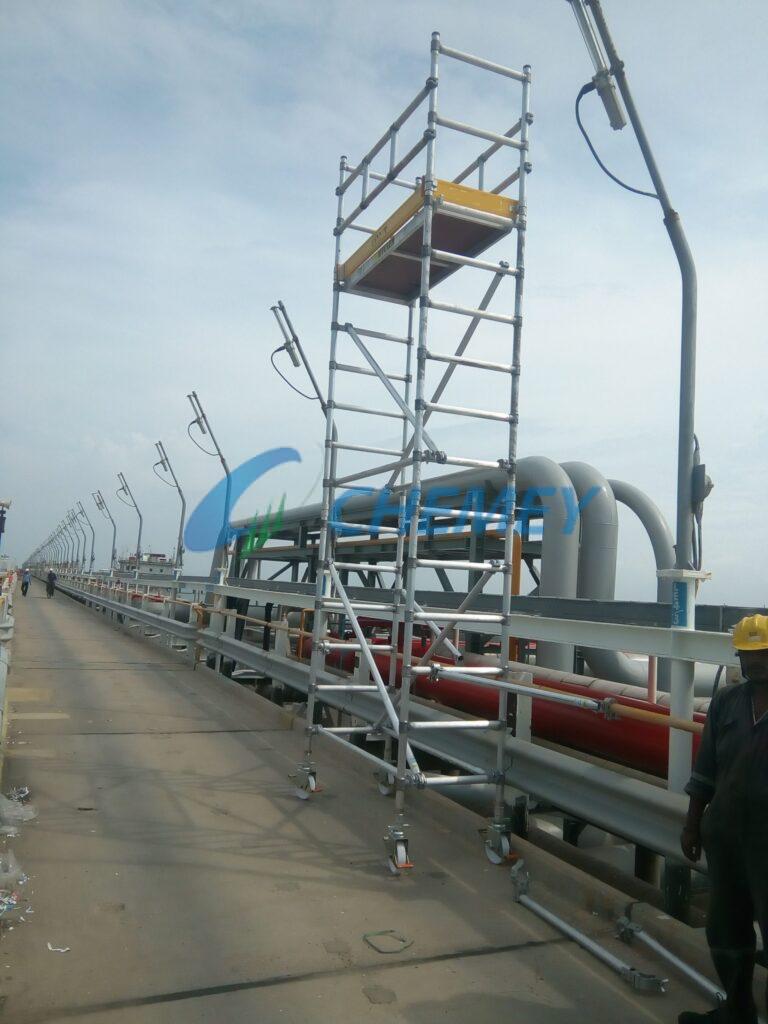
Anyone who works in the construction business is most likely familiar with scaffolding. Scaffolds provide construction workers with a temporary platform on which to work and are most used for either building-repairing or cleaning a structure, Maintenance of Lights and Other machinery where approach is difficult. Scaffolds are generally made out of steel or aluminum, but for those who work in construction, there are many advantages to using aluminum scaffolds even though they cost more than steel scaffolds. Here are five advantages that aluminum scaffolding has to offer over steel scaffolding. Aluminum Scaffolding is Lightweight Scaffolding made from aluminum weighs much less. In fact, an aluminum scaffold that is less than half as much as one made out of steel. Because of its light weight, not only is aluminum scaffolding easier to transport from one location to the next, but also it is easier to erect and dismantle when on the job site. Less Labor Required for Aluminum Scaffolding Erection When aluminum scaffolding is used there is generally less labor required. Not only is less manpower needed, but also cranes might not be needed either. When working with aluminum scaffolding, it minimizes the risk of injuries and lifting incidences while on the job. When aluminum scaffolding is used instead of steel scaffolding, only two men may be required to erect and dismantle against four men required for Steel. Also, aluminum scaffolding can be transported in a smaller truck. Aluminum Scaffolding Can Erect More Quickly Scaffolding made from aluminum is easier to set up in general, and also goes up more quickly than scaffolding made out of steel. Aluminum scaffolding comes equipped with high strength casters making installation fast and easy. Its H frame structure block combination design usually doesn’t require any kind of installation tools. Because they are so easy to assemble and take apart, construction workers can get from one job site to another with minimal downtime. Aluminum Scaffolding Has a Variety of Uses No matter what kind of job you need a scaffold for, aluminum scaffolding has a variety of uses. Here are just a few of them: a. Narrow span and wide Span scaffolds – rolling towers that can get erected without the need for any tools b. Stairway – Ease of access to platforms when required for safe climb with tools and machinery c. Folding base scaffolds – unfolds and locks into place to provide an instant base Besides these types of scaffolds, custom scaffolds can also be made of aluminum. Aluminum Scaffolding Lasts Longer If scaffolding made from aluminum gets scratched, it forms an oxidized layer that helps to protect the inner core. This natural layer of aluminum oxide prevents the metal underneath it from getting exposed to air and oxygen. Compare this when scratching scaffolding made from steel, which can potentially rust and will eventually weaken the structure of the scaffold. Even after aluminum scaffolding gets used over and over again, and gets exposed to the elements, it won’t chip or rust. Aluminum is also known for being dent resistant and more resilient, which not only makes it durable, but also helps it to last longer.
Preventing Falls From Height – Spring Loaded Safety Gates
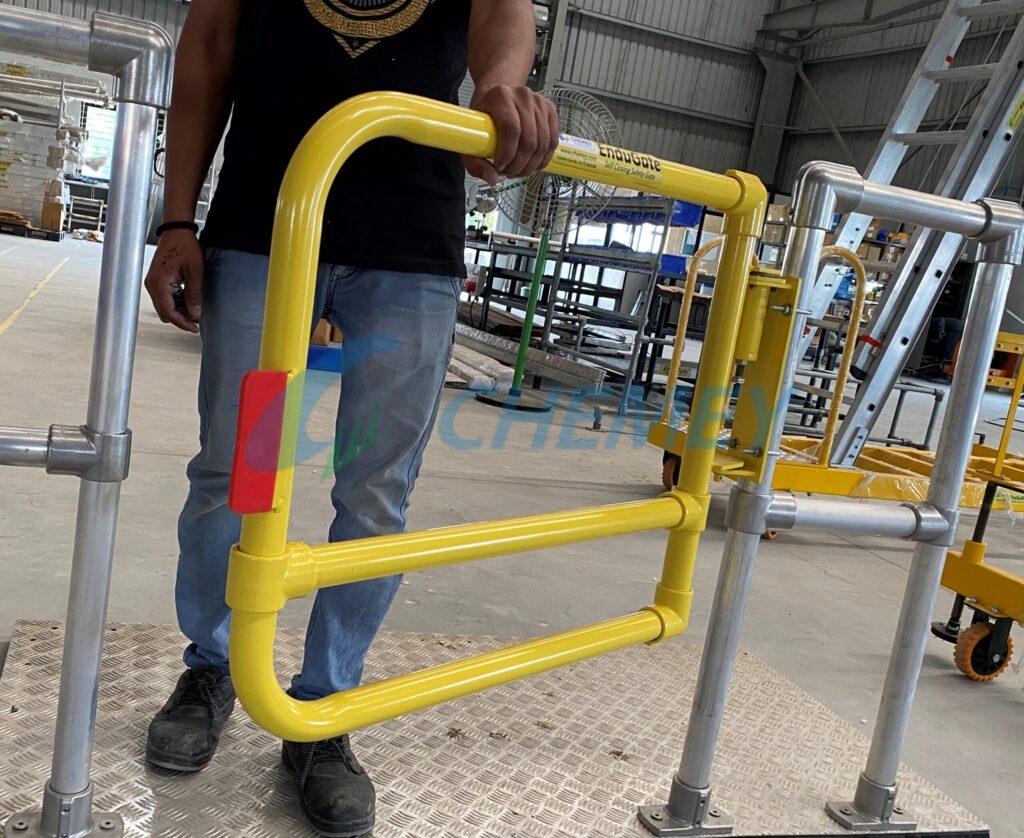
If a ladder is being used to access the machinery or monitoring platforms, then a safety solution needs to be in place. Customers are in search of solutions, where and how this form of protection should be taken care of in a work environment. Breaks in railing systems areas have tended to be protected by chains or bars, but the problem with this method is that they are completely reliant on the person remembering to replace the chain or bar once they’ve passed through. If the safety component is not replaced the area will be left exposed, which could mean someone falling from a platform or gaining unauthorized access to a restricted area Spring-loaded safety gates, or industrial safety gates as they are sometimes referred to, are an ideal solution to protecting open voids such as on a platform, mezzanine floor, and machinery stairways or for providing safe access and egress to demarcated areas within factories, warehouses, and loading bays. Chemey range of self-closing safety gate overcome the risk of human error that’s associated with chains and sliding tubes as they automatically close behind the user, overcoming the risk of human error to eliminate such risk of injury. Safety must always be a priority. In addition to being a simple and extremely effective way of ensuring safety that isn’t reliant on the user, spring-loaded safety gates help you to follow HSE guidelines and comply with current legislation such as BS EN 14122 Parts 3 and 4. BS EN 14122 states that gates on handrails must close automatically when released and that if an access point is required along a guard rail, there must be a self-closing gate.
Modular Aluminium Handrails – New Perspective For Long Lasting Safety
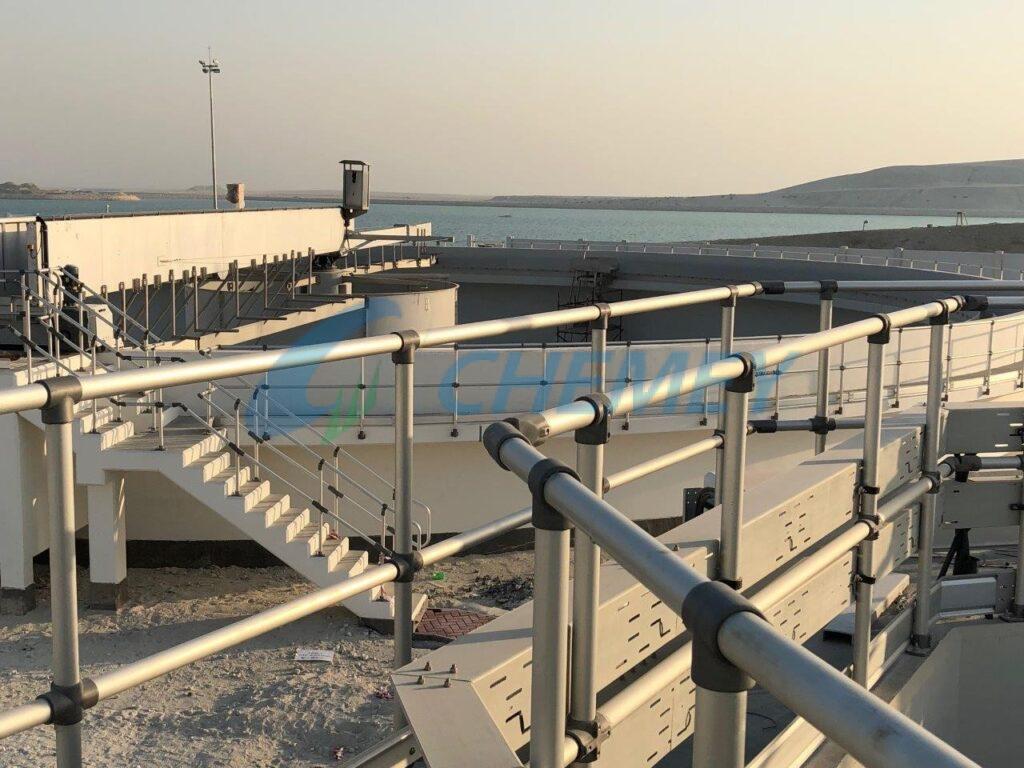
Handrails are mostly a neglected topic while executing projects but are very important during operation of any plant as they directly affect safety at workplace. The most common MOC accepted is MS + Painting. In typical Industrial / Coastal environments, MS tends to rust both from the Inside & Outside, thus compromising safety after 2 to 3 years of installation. (See Picture below). Repainting /maintenance of Railing within Operational plant ends up in high costs and invites unwanted conditions like Hot-work permission. Performance Standards of Handrails: Well OSHA 1910.23, EN 14122-3 ( BS 4592 -3 ) along with ASTM E935 & E985 address most of Design Criteria for Handrails like Configuration, define UDL and Point load Handrail should withstand and how to test designed Handrails. EnduRail railing systems and fittings designed with below-listed features address most of your Handrails concerns: Truly Modular System: No hot work required for erection and Can accommodate a last-minute change in configure Corrosion Free: Made from Marine Aluminium Magnesium Silicon alloy and are practically corrosion-free in Marine and most Harsh Industrial Compliances: EnduRail railing system complies with OSHA/EN/BS Lowest Life Cycle Designed to Accommodate Standard Pipe Size: Fittings available to accommodate 25NB or 33mm OD, 32NB or42 mm OD,40NB or 48mm OD High Aesthetic Appeal: Finish Options– Anodized or Polyester Powder coated.